
Case study 02 / Homeowner resource + local SEO
Turning Seawall Anxiety into a Homeowner Decision System.
Waterfront homeowners often begin with a symptom...a crack, a leaning panel, a sinkhole, soil washing away, or damage after a storm. Tight Designs turned those anxious questions into a 73-route, source-led website that helps Englewood property owners understand the issue, compare options, find the right local guidance, and request an estimate without being pushed into a premature answer.
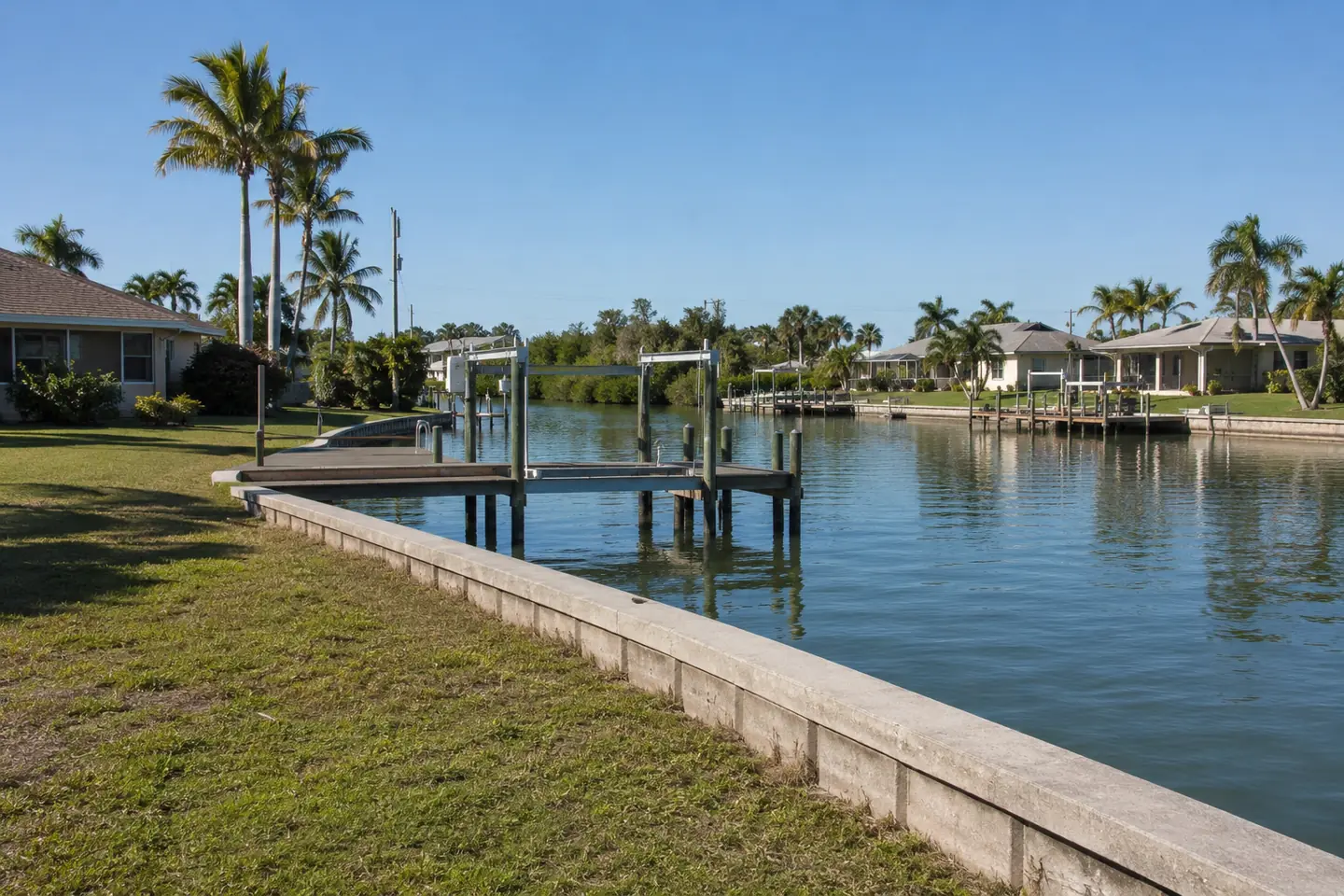
A local resource designed around the homeowner's next responsible decision.
EnglewoodSeawall.com began with a difficult content problem. The subject is technical, the stakes can be expensive, and the reader may arrive immediately after noticing damage. Search results often collapse inspection, engineering, permitting, repair, replacement, erosion control, and sales into one answer. That is not how a waterfront property decision actually works.
Tight Designs built the website as an independent, homeowner-first guide. It explains common seawall systems, symptom patterns, inspection questions, maintenance considerations, storm effects, cost factors, and permit pathways. It also acknowledges the limits of a website. A page can help someone recognize the questions to ask, but it cannot inspect the property, identify hidden structural conditions, determine jurisdiction, promise approval, or replace advice from a qualified professional.
The result is a connected local authority platform with 73 indexable routes. Ten topic hubs organize the research journey. Local pages address Lemon Bay, Manasota Key, Englewood canals, Placida, and Stump Pass. Permit guidance is separated for Charlotte County and Sarasota County. Estimate and contact paths allow a prepared homeowner to share the concern, property context, and photographs for follow-up.
Research strategy
Homeowner intent, symptom paths, primary sources, jurisdiction boundaries, topic clusters, and internal-link relationships.
Experience design
Responsive layouts, plain-language explanations, site search, checklists, comparison tools, and clear decision paths.
Local content
Original guides for wall systems, conditions, costs, permits, storms, maintenance, Lemon Bay, and Englewood waterways.
Development
Generated static HTML, shared components, structured data, secure forms, analytics, sitemaps, and automated quality gates.
High-stakes questions rarely arrive in neat keyword categories.
A homeowner may call every shoreline structure a seawall, while an engineer, contractor, regulator, and insurer may distinguish among bulkheads, revetments, riprap, retaining systems, caps, tiebacks, panels, and living shoreline approaches.
“The reader does not need a confident guess. They need a clearer path from symptom to qualified next step.”
The project had to be useful enough to reduce confusion while remaining disciplined about technical and regulatory boundaries. That meant writing for ordinary homeowners without flattening the subject, building commercial pathways without disguising sales copy as engineering advice, and developing local relevance without pretending every canal or property has the same conditions.
Symptom-first arrival
Cracks, leaning, washout, voids, rust, cap movement, tieback failure, or storm damage may be the first clue...not the final diagnosis.
Split local jurisdiction
Englewood crosses Charlotte and Sarasota Counties, and the applicable agency path depends on the parcel, waterway, work, and current rules.
Expensive uncertainty
Cost depends on access, wall system, length, soil, water conditions, engineering, permitting, mobilization, and hidden damage. A universal price would mislead.
Editorial responsibility
The website is not a government office, engineering firm, contractor, insurer, law firm, or emergency service. Those boundaries need to remain visible.
Organize the website around decisions rather than a single sales funnel. A visitor can identify a symptom, learn the vocabulary, compare approaches, understand local process questions, review storm and maintenance context, then decide whether to document the condition, contact the appropriate agency, seek professional evaluation, or request an estimate.
Ten hubs turn a complicated shoreline topic into connected decisions.
The structure moves from broad understanding to specific homeowner questions. Each cluster has a clear role, distinct intent, contextual internal links, and a route back to the most responsible next action.
Seawalls
Core explanations of shoreline walls, bulkheads, their components, how systems differ, and where professional evaluation belongs.
Types + materials
Concrete, vinyl, steel, wood, riprap, revetments, sheet pile, living shoreline options, and side-by-side decision context.
Problems
Cracking, leaning, erosion, soil loss, sinkholes, tieback concerns, drainage, cap damage, and symptom-led warning signs.
Costs
Cost factors, repair versus replacement questions, estimate preparation, access, permitting, and why one online number is unreliable.
Inspection + maintenance
What to observe, what to photograph, seasonal checks, maintenance planning, and when a concern deserves professional attention.
Permits
Separate Charlotte County and Sarasota County paths, plus state and federal context when shoreline work may involve other agencies.
Storms
Damage patterns and source-led local context for Hurricane Ian, Hurricane Helene, Hurricane Milton, and post-storm inspection decisions.
Local conditions
Lemon Bay, Englewood canals, Manasota Key, Stump Pass, Placida, tidal water, access, exposure, and waterfront-property context.
Homeowner guides
Checklists, planning tools, first conversations, estimate preparation, photographs, records, and questions for qualified professionals.
Learn
Plain-language terminology, methods, sources, comparisons, and foundational concepts that support the rest of the website.
| Search intent | Content system | Question answered | Responsible next step |
|---|---|---|---|
| “types of seawalls” | Types hub + material guides | How do common systems differ? | Understand the vocabulary before comparing options |
| “riprap vs seawall” | Comparison guide + revetment cluster | Are these the same solution? | Compare purpose, site factors, tradeoffs, and agency questions |
| “seawall tieback rods” | Component guide + problem pages | What restrains the wall and what can failure look like? | Document symptoms and seek qualified evaluation |
| “storm damage seawall” | Storm hub + inspection guidance | What should be checked after severe weather? | Prioritize safety, photographs, records, and professional follow-up |
| “seawall construction cost” | Cost hub + estimate preparation | Which variables shape the number? | Gather enough property detail for a meaningful estimate |
Englewood is one community across two counties.
A generic Florida seawall page cannot explain the local decision. The site connects Lemon Bay, Manasota Key, Stump Pass, Placida, residential canals, tidal conditions, storm history, access questions, and the county line to the homeowner's research. It also avoids treating those places as interchangeable. A bayfront property, canal lot, pass-adjacent shoreline, and protected waterway can raise different exposure, access, habitat, and regulatory questions.
Permit content is deliberately divided between Charlotte County and Sarasota County. State and federal references are layered in where Florida Department of Environmental Protection or United States Army Corps of Engineers guidance may matter. Each regulatory guide includes source links and a verified date so the visitor can confirm current information with the agency responsible for the property and proposed work.
Calm, useful, and serious enough for the decision.
The design avoids contractor-site clichés and disaster imagery used only to create fear. Strong typography, restrained coastal color, structured comparisons, diagrams, and original photographs help the reader study the condition without turning concern into pressure.
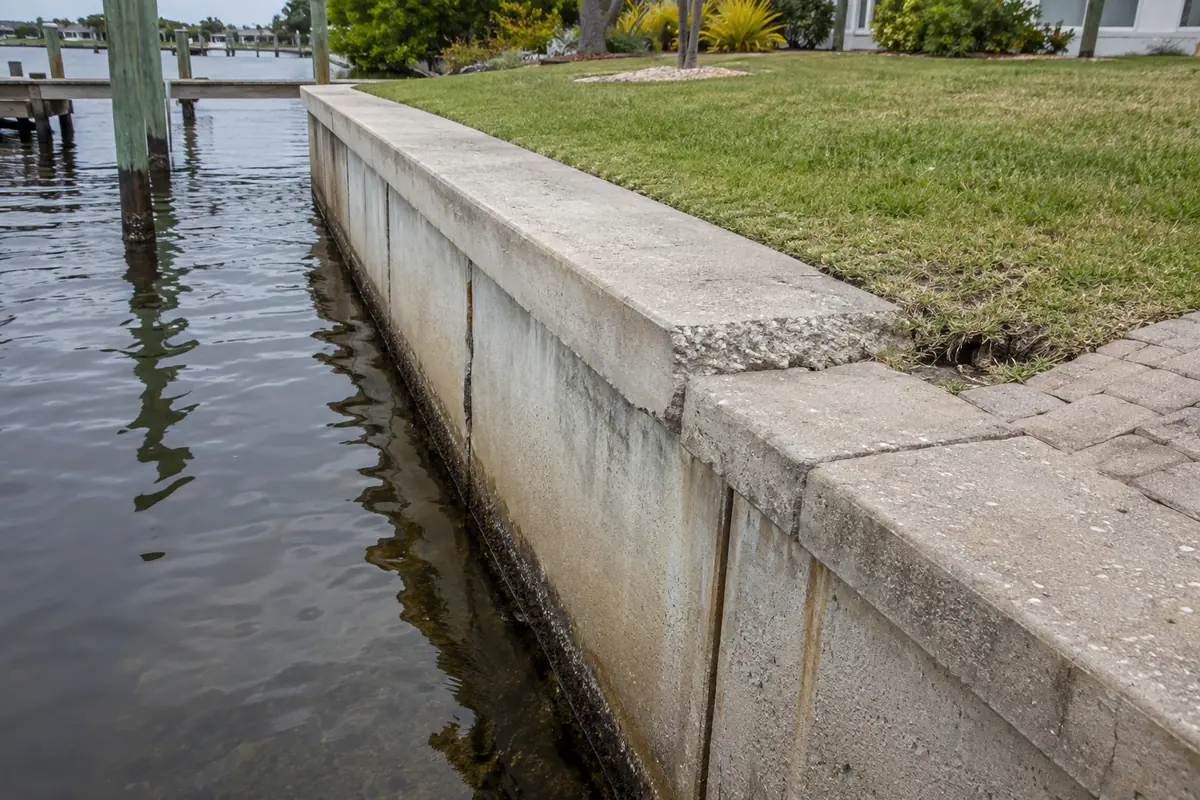
Show what homeowners inspect... then explain what a photograph cannot diagnose.
Original imagery gives the guidance a real local texture. Captions and surrounding copy distinguish visible conditions from structural conclusions that require on-site professional evaluation.
The project uses original, locally stored WebP photography as educational context. Images illustrate conditions and property relationships. They are not presented as an engineering assessment of a specific property or proof that one repair method is appropriate.
Education earns the right to ask for the estimate.
The conversion path respects the order in which a homeowner thinks. It begins with the observed problem, acknowledges the uncertainty, provides a usable answer, shows what changes when the reader is prepared, and defines a realistic end result.
“Something looks wrong along the water, and I do not know how serious it is.”
Symptom pages meet the homeowner at the visible concern rather than assuming a confirmed diagnosis or preferred construction method.
Recognize the cost, safety, property, storm, and permit questions behind the search.
Plain language reduces confusion without pretending a web page can remove every uncertainty.
Connect the symptom to terminology, comparisons, local process, and inspection questions.
Each route provides context and points to official sources or qualified evaluation where the decision leaves the website's boundary.
Turn a vague worry into organized property information.
The homeowner can collect photographs, wall length, access notes, county, timing, observed changes, and relevant records before requesting help.
A more useful first conversation and a more responsible next step.
The form begins an estimate or follow-up process. It does not promise a diagnosis, permit, scope, price, schedule, or engineering conclusion.
Estimate and contact pages do not contain advertising reserves. Required fields, consent language, photo rules, and clear response expectations help protect both the homeowner and the business conversation.
Seventy-three public routes...one generator, one component system.
The live HTML is committed for reliable Hostinger deployment, but global page structure is not edited 73 times. Source modules control the shared identity, navigation, footer, search data, content registry, source records, FAQs, schemas, forms, tools, and page relationships.
Generated static HTML
Each route ships as complete HTML with its title, description, canonical URL, headings, breadcrumbs, content, internal links, and structured data available before JavaScript.
Client-side site search
A generated search index lets visitors search for symptoms, wall types, permit questions, storm topics, and local guides without depending on an external search provider.
Homeowner planning tools
Inspection and planning resources help visitors organize observations, questions, and next steps. Browser storage supports useful interaction without turning the site into a login platform.
Protected form handling
Estimate and contact forms use authenticated server mail, honeypots, rate limits, validation, and controlled photo attachments. Credentials remain outside the public repository.
The content system enforces the fundamentals.
- Unique titles, meta descriptions, canonical URLs, H1 headings, introductions, and relevant internal links
- Visible breadcrumbs paired with BreadcrumbList structured data
- WebSite, WebPage, Article, FAQPage, and organization context where appropriate
- XML sitemap generated from the same route registry as the website, plus an HTML sitemap and robots file
- Depth gates for high-priority seawall, bulkhead, riprap, revetment, cost, tieback, storm, and project-story pages
- Exact intent checks for important homeowner searches and minimum contextual internal-link requirements
- Responsive local WebP imagery, semantic landmarks, visible focus styles, labels, skip navigation, and reduced-motion support
- Custom 404, privacy, terms, accessibility, editorial, sources, advertising, corrections, disclosure, and methodology pages
Authority comes from showing the work behind the answer.
The website maintains 24 documented source records, led by government and technical resources. Regulations, storm history, living shoreline concepts, tide context, coastal conditions, and permit pathways are connected to the source responsible for the information.
Primary-source foundation
- Charlotte County and Sarasota County department guidance
- Florida Department of Environmental Protection resources
- United States Army Corps of Engineers permit and design references
- NOAA, National Weather Service, National Hurricane Center, FEMA, and local recovery information
Visible editorial boundaries
- No claim to be a government agency or permitting authority
- No online engineering diagnosis or universal repair prescription
- No legal, insurance, emergency, or structural-safety representation
- Verified dates and official links on regulation-sensitive guidance
Transparent business model
- Estimate and contact pathways are clearly identified
- Advertising reserves remain labeled and hidden until valid configuration exists
- Estimate and contact pages remain free from ad placements
- Advertising disclosure and how-we-make-money pages explain commercial context
Safer homeowner interaction
- Photo uploads limited to supported image types and controlled file sizes
- Spam controls, rate limiting, required fields, and consent
- Privacy, terms, disclaimer, accessibility, and corrections processes
- Emergency and technical concerns directed beyond the website when appropriate
The launch created a measurable authority platform. Performance claims wait for evidence.
EnglewoodSeawall.com went live in August 2026. The current story is the verified platform, the search feedback already informing editorial priorities, and the instrumentation needed to measure what happens next.
Google Search Console has begun surfacing the language people use around seawalls, bulkheads, materials, riprap, revetments, tiebacks, storm damage, and costs. No ranking position, traffic increase, estimate increase, or revenue increase is claimed without a stable baseline and first-party reporting.
Search demand is already refining the content.
After launch, high-impression phrases around seawalls and bulkheads, steel and vinyl systems, concrete walls, riprap, rock revetments, storm damage, tieback rods, and construction cost were mapped back to specific guides. Priority pages were expanded, intent language was clarified, and contextual internal links were strengthened. That is the purpose of measurement...not merely reporting a number, but improving the answer.
A complex topic without an organized local path
Homeowners had to piece together technical vocabulary, county differences, storm context, repair questions, and official sources across disconnected search results.
A connected Englewood homeowner resource
Seventy-three routes now connect symptoms, systems, costs, permits, storms, maintenance, local conditions, sources, tools, and estimate preparation within one shared experience.
What the Englewood Seawall launch included.
The assignment covered the research experience, public website, lead pathway, technical foundation, and editorial safeguards required to keep a high-stakes local topic useful.
- Homepage and homeowner start-here journey
- Ten core topic hubs and 73 indexable routes
- Seawall, bulkhead, wall-type, material, and component guides
- Symptom-led problem and warning-sign library
- Cost factors, repair-versus-replacement, and estimate-preparation resources
- Inspection, maintenance, and planning checklists
- Separate Charlotte County and Sarasota County permit guidance
- Hurricane Ian, Helene, Milton, and storm-damage resources
- Lemon Bay, Manasota Key, Englewood canal, Placida, and Stump Pass context
- Site search, glossary, comparison paths, tools, and source methodology
- Original local photography and responsive WebP variants
- Estimate and contact forms with validated photo attachments
- Editorial, disclosure, advertising, corrections, privacy, terms, disclaimer, and accessibility pages
- Unique metadata, canonicals, schema, breadcrumbs, XML and HTML sitemaps, robots, and 404
- GA4, Search Console feedback, deployment documentation, and automated validation
Useful local SEO reduces uncertainty before it promotes a service.
Symptoms and solutions are different intents.
A homeowner searching for soil loss is not necessarily ready to choose vinyl, concrete, steel, riprap, or any construction method. The architecture has to preserve that distinction.
Local detail includes jurisdiction.
Englewood's Charlotte and Sarasota County split materially affects the research path. Naming Lemon Bay is not enough if the site ignores who regulates the work.
Source transparency is part of design.
Verified dates, official links, editorial boundaries, and correction pathways should be visible features...not notes hidden behind the interface.
Search data should change the website.
Impression queries become useful when they reveal a missing explanation, weak intent match, incomplete comparison, or internal-link opportunity.
Questions about the Englewood Seawall website
What did Tight Designs build for Englewood Seawall Guide?
Tight Designs created the positioning, information architecture, homeowner decision paths, responsive design, original educational content, source registry, local search strategy, static-site generator, client-side search, planning tools, estimate and contact forms, analytics, structured data, accessibility foundation, and launch validation for EnglewoodSeawall.com.
How large is the EnglewoodSeawall.com website?
The current website contains 73 indexable routes organized around ten core topic hubs. The system covers wall types, common problems, costs, inspections and maintenance, permits, storm damage, local conditions, homeowner guides, learning resources, and conversion pages.
How does the website handle seawall permits in Englewood?
It separates Charlotte County and Sarasota County guidance because Englewood spans both jurisdictions. Permit pages explain the questions a homeowner should ask, link to relevant official agencies, show a verified date, and remind readers that the correct process depends on parcel location, scope, waterway, and current agency rules.
Does this case study claim rankings, traffic, or estimate growth?
No. The site launched in August 2026 and is still building its performance baseline. This case study reports verified scope, implementation, early search-query signals, and measurement readiness. It does not invent position, traffic, inquiry, or revenue improvements.
Why is Englewood Seawall Guide positioned as an independent homeowner resource?
A homeowner facing erosion, cracking, soil loss, or storm damage needs to understand the problem before comparing solutions. The site clearly states that it is not a government agency, engineering firm, contractor, insurer, law firm, or emergency service. It provides organized education, primary-source links, and a path to request an estimate while directing technical decisions to qualified professionals.
Can Tight Designs create a similar local authority website for another service business?
Yes. The reusable method combines buyer questions, topic clusters, honest local context, source-backed content, shared components, technical SEO, and measurable conversion paths. The actual architecture and claims should always be shaped around the business, its customer, its geography, and the evidence available.