
Case study 03 / Local service + appointment planning
Designing a Mobile Notary Website Around the Trip... Not Just the Stamp.
A mobile notary does more than arrive with a seal. The appointment depends on the document, the signer, identification, witnesses, location, timing, travel, access, and the correct notarial act. Tight Designs turned those moving parts into a 19-route local website that helps Englewood-area customers prepare before anyone gets in the car.

 Local appointment-planning website
A local-service website that prepares the appointment before it generates the request.
Mobile notary searches often look deceptively simple. Someone needs a signature notarized and wants a professional to come to them. In practice, the notary cannot choose the legal act, give legal advice, complete an unfinished document, identify a signer without acceptable evidence, or proceed when the signer is unwilling or unable to communicate. A visit can also fail because a witness is missing, a facility has access rules, a gate code was not supplied, or a ferry schedule was treated like ordinary driving time.
Tight Designs built Mobile Notary Englewood as a preparation and route-planning system rather than a one-page list of documents. Five detailed service pages explain common appointment categories. Six service-area paths describe actual Southwest Florida travel. Pricing separates the notarial act from the mobile trip. Preparation, identification, FAQ, and appointment pages reduce the avoidable friction that can waste time for the signer and the notary.
The strongest local distinction is the island-service pathway. Palm Island, Knight Island, and Don Pedro Island do not have bridge access. The website explains how vehicle-ferry or water-taxi planning, fares, waiting, parking, document readiness, signer readiness, and witnesses affect the appointment. That is the kind of operating detail that creates local authority because it genuinely changes the service.
Positioning
Mobile convenience framed around careful preparation, transparent route planning, and clear professional boundaries.
Local SEO
Service, pricing, preparation, FAQ, and service-area architecture connected through page-specific internal links.
Conversion
A planning calculator and structured appointment request that collect useful details without requesting private documents.
Development
Shared React components, centralized content, generated metadata, static output, structured data, and automated tests.
Convenience cannot come at the expense of readiness.
The visitor wants the notary to travel. The notary needs enough information to determine whether the appointment can proceed, how the route should be planned, and what costs need to be confirmed before leaving.
“The document stays with you. The notary comes to it.”
That promise works only when the supporting process is equally clear. The website had to sell convenience without suggesting that every document can be notarized, every signer is ready, every location is equally accessible, or every price can be reduced to the state fee for one notarial act.
Professional boundaries
A Florida notary cannot select the legal act for the signer, draft the document, explain legal consequences, or substitute for an attorney.
Appointment dependencies
Complete pages, original identification, personal appearance, willingness, awareness, communication, witnesses, and facility access may all matter.
Two kinds of cost
The permitted notarial fee and the business cost of a mobile visit are related to the same appointment but should not be presented as one unexplained number.
Unusual local routes
Beach bridges, tolls, marinas, gates, care facilities, and ferry-only islands make a simple radius or mileage promise incomplete.
Design the website around a prepared visit. Every important path helps the visitor identify the document category, required people, acceptable identification, meeting conditions, route factors, notarial acts, and timing before requesting the appointment.
Nineteen routes cover the service, the trip, and the questions between them.
The architecture avoids creating dozens of thin city pages. Each route has a distinct job in the customer journey and a real reason to exist.
Mobile notary services
A service hub connects general notarizations, estate and family documents, real estate documents, care-setting visits, and eligible VIN verification.
Transparent pricing
The pricing page distinguishes notarial acts from mobile travel, explains added route factors, and provides an interactive planning estimate.
Appointment checklist
Document completeness, identification, witnesses, signers, willingness, communication, access, and timing receive their own planning path.
Acceptable identification
A dedicated guide explains why original identification and Florida requirements should be reviewed before the appointment.
Service areas
Englewood, Venice, Rotonda West, Manasota Key, Grove City and Placida, plus Palm, Knight, and Don Pedro Islands.
Request an appointment
The form asks for the document category, location, signers, estimated acts, timing, and access details without requesting confidential document text.
| Visitor intent | Page system | Question answered | Conversion role |
|---|---|---|---|
| “mobile notary Englewood FL” | Homepage + Englewood page | Will the notary travel to my location? | Introduce service fit and route planning |
| “hospital notary near Englewood” | Care-setting service guide | What has to be ready at a hospital or senior-living facility? | Reduce failed visits caused by access or signer-readiness problems |
| “mobile notary fees Englewood” | Pricing page + calculator | What is the act fee and what belongs to the trip? | Create a realistic estimate before the request |
| “notary Manasota Key” | Manasota Key service-area page | How do bridge travel, parking, address, and timing affect service? | Collect useful route information |
| “notary Don Pedro Island” | Barrier-island service-area guide | How is a ferry-only appointment different? | Qualify access, transit, timing, and readiness before travel |
A nearby address is not always a simple drive.
The website understands that “Englewood area” can mean a home near Lemon Bay, a Manasota Key address across the beach bridge, a care facility in Venice, a gated property in Rotonda West, a marina or job site around Grove City and Placida, or a barrier-island destination without bridge access. These are not keyword variations. Each one affects the questions the notary needs to ask.
The Palm, Knight, and Don Pedro Island guide links to Palm Island Transit information and treats ferry fare, waiting, boarding, parking, and vehicle access as separate planning factors. Signer identification, witnesses, document completeness, and the intended notarial act are checked before the route becomes expensive. This is local content with operational value.
Professional enough for legal documents...warm enough for someone asking for help.
The visual system uses deep navy, coastal blue-green, cream, and a restrained coral accent. Clear typography, generous space, local imagery, and structured cards make the process feel calm without making the service feel casual.
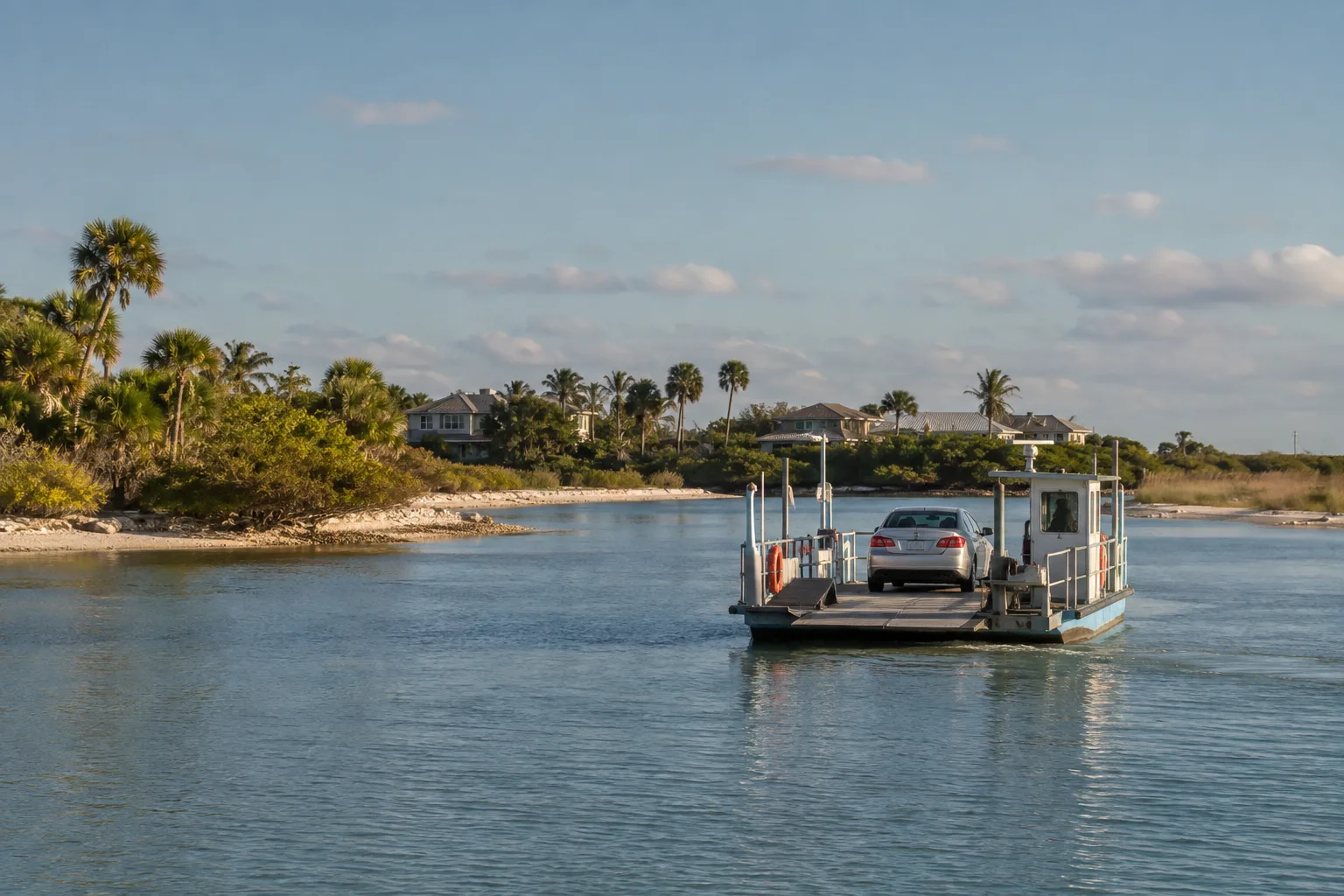
The ferry route became proof of real service-area knowledge.
Most local-service websites draw a circle around a city. This project explains what changes when the destination requires transit coordination before the signing can begin.
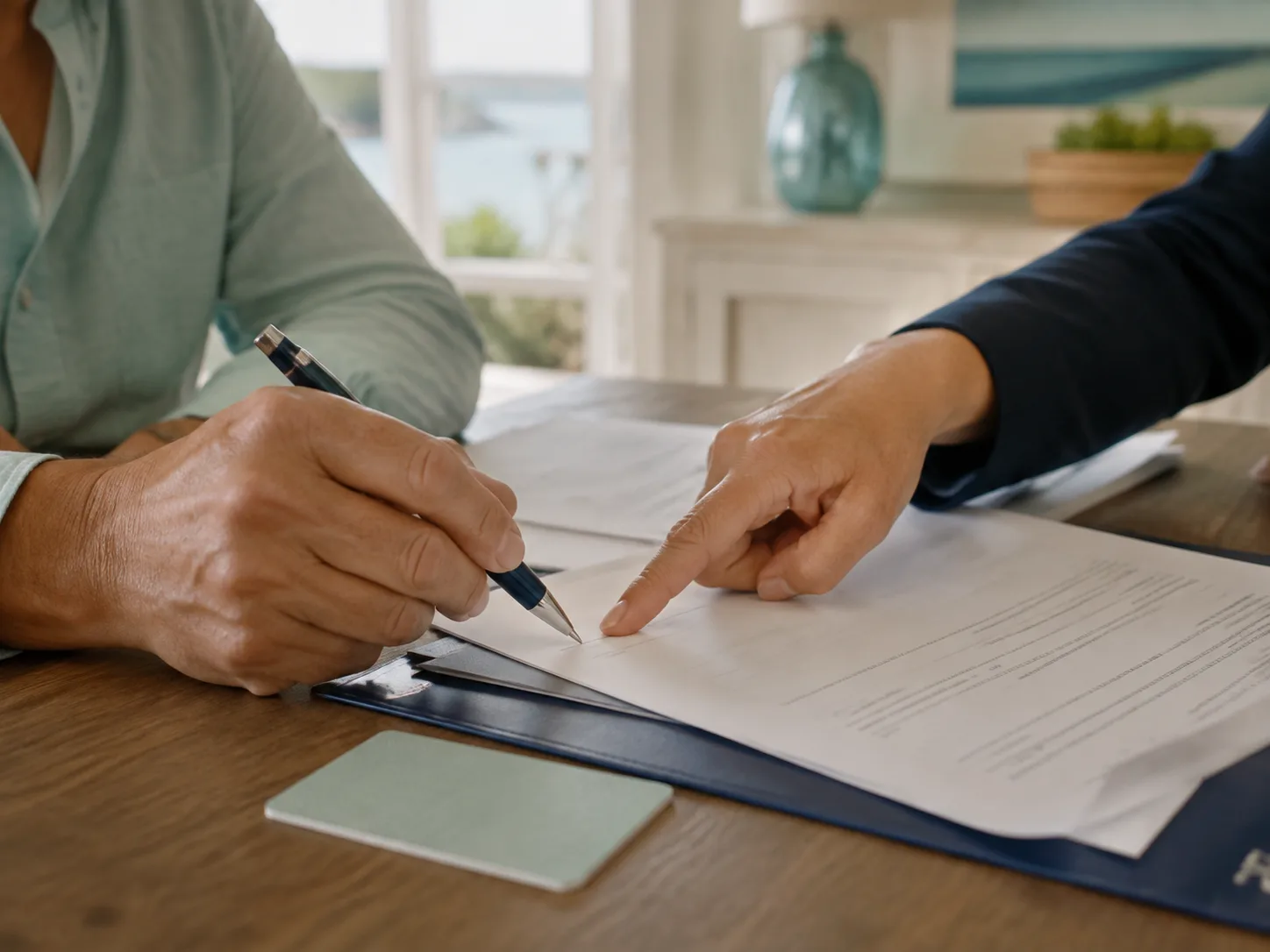
The project imagery was created for the website and stored with the site assets. It supports the appointment story without claiming to document a particular signer, notary, client, facility, or completed notarial act.
Move from “I need a notary” to “this appointment is ready.”
The conversion path solves for readiness rather than maximizing form submissions. A prepared request is worth more than a lead that cannot become a lawful, efficient appointment.
“The document and signer are here, but getting to a notary is difficult.”
The homepage starts with mobile convenience at homes, offices, facilities, marinas, job sites, and island addresses.
Acknowledge the real stress behind the request.
The signer may be in a care setting, the timing may matter, transportation may be limited, or the route may be unusually complicated.
Explain the service, preparation, route, and pricing before asking for private details.
Service and guide pages answer the questions needed to determine whether the appointment can proceed.
Turn an urgent request into an organized visit.
The customer identifies the document category, signers, acts, location, witnesses, access, and preferred timing.
A clearer quote and a better chance of completing the appointment once.
The request begins a conversation. Travel starts only after the time, route, preparation, and total quote are confirmed.
The appointment form explicitly tells visitors not to paste Social Security numbers, ID numbers, medical details, or confidential document text. It collects logistics, not the private contents of the document.
Nineteen indexable routes...one content and component system.
Navigation, service-area links, contact configuration, metadata, breadcrumbs, FAQ markup, calls to action, footer content, styles, and page rendering are shared. A new route begins as a content record instead of a copied page.
Centralized page registry
Seventeen service, guide, FAQ, and service-area content records feed one route template with unique metadata, sections, FAQs, related links, and breadcrumbs.
Interactive pricing model
Four meeting zones, estimated acts, and round-trip mileage create a planning estimate while keeping ferries, tolls, parking, witnesses, printing, waiting, and special timing visible.
Safer request handling
The form includes required fields, a honeypot, status feedback, consent, sensitive-data warnings, and environment-controlled public contact details.
Two production targets
The same source can produce conventional static files for Hostinger or a Worker-compatible build. The deploy branch is reserved for the generated static export.
Every indexable route explains its own purpose.
- Unique page title, meta description, canonical URL, H1, introduction, structured sections, and contextual FAQ answers
- ProfessionalService structured data on the homepage with service areas and service type
- Visible breadcrumbs paired with BreadcrumbList structured data on shared content pages
- FAQPage markup generated from each page's relevant question set
- Open Graph and social metadata with a project-specific social image
- XML sitemap and robots file generated from the same page registry used by the website
- Responsive WebP images, favicon, brand marks, manifest, privacy page, and custom not-found experience
- Automated rendered-route tests that reject missing H1 headings, generic starter language, invalid sitemap URLs, and blocked crawling
The trust system includes what the website refuses to promise.
A notary website sits close to legal documents and sensitive personal situations. Clear boundaries are not merely disclaimers. They shape the copy, form, pricing, and interaction design.
Florida-specific boundaries
- No promise to choose the notarial act for the signer
- No document drafting or legal interpretation
- No guarantee that an incomplete or unsuitable document can proceed
- Direct links to Florida statute, state notary information, and the Governor's reference manual
Transparent pricing logic
- Traditional notarial act shown separately from mobile travel
- Route zones and additional mileage explained
- Ferry, toll, parking, witness, printing, waiting, and timing factors disclosed
- Planning estimate distinguished from the final confirmed quote
Accessible interaction
- Semantic headings, landmarks, breadcrumbs, labels, lists, links, and forms
- Skip navigation, keyboard access, visible focus states, and responsive layouts
- Live form status messages for success and failure
- Descriptive alternative text and reduced reliance on decorative imagery
Privacy-conscious requests
- No document upload required to begin planning
- Explicit warning against confidential document text and ID numbers
- Contact details controlled through the deployment environment
- Appointment request distinguished from confirmation or legal consultation
The website is complete enough to measure...not old enough to exaggerate.
The production system was completed in August 2026. The defensible result is the published architecture, user preparation, local depth, conversion logic, and measurement readiness. Organic and appointment performance still need a real baseline.
No search-position increase, organic-traffic increase, appointment increase, or revenue increase is claimed. Those outcomes should be added only with a defined date range, data source, baseline, and conversion definition.
Judge the site by prepared appointments...not raw form volume.
The strongest conversion is not simply a submitted form. It is a request with enough information to quote the route, confirm the requested act, identify missing preparation, and determine whether the appointment can reasonably proceed. Analytics configuration is centralized so the site can measure the paths that create those conversations.
A service idea with many hidden appointment variables
Travel, act fees, identification, witnesses, care settings, private locations, ferries, and signer readiness could easily become a confusing first conversation.
A structured local appointment-planning platform
Nineteen routes now connect the service, price, preparation, identification, geography, legal boundary, local route, and request details in one shared system.
What the Mobile Notary Englewood build included.
The project covered the customer-facing website and the shared technical system needed to keep future service and service-area changes consistent.
- Homepage and mobile-notary positioning
- Service hub and five detailed service pages
- General, estate and family, real estate, care-setting, and VIN-verification guidance
- Transparent pricing guide and interactive estimate calculator
- Appointment-preparation and acceptable-identification resources
- Service-area hub and six local area pages
- Englewood, Venice, Rotonda West, Manasota Key, Grove City, and Placida context
- Palm, Knight, and Don Pedro Island ferry-aware guide
- FAQ collection with 57 contextual question records
- Appointment form, privacy page, and not-found experience
- Original project imagery, logo marks, favicon, manifest, and social card
- Shared header, footer, navigation, breadcrumbs, CTA, page layout, and styles
- Unique metadata, canonicals, structured data, XML sitemap, and robots file
- Static Hostinger export and Worker-compatible production build
- Environment-controlled contact details, analytics hook, tests, and deployment documentation
Local service content becomes stronger when geography changes the work.
Price transparency needs categories.
The act fee, mobile visit, mileage, transit, parking, witnesses, printing, waiting, and special timing should not be collapsed into an unexplained starting price.
Preparation is part of the offer.
Helping the customer arrive with complete documents, proper identification, the right people, and access details protects the convenience being sold.
Local knowledge should affect the interface.
Barrier-island service is not just a paragraph mentioning Don Pedro. It changes the calculator assumptions, request questions, route timing, cost disclosure, and preparation sequence.
Boundaries can improve conversion.
Explaining what a notary cannot choose, advise, or guarantee filters the wrong expectations and makes the appropriate appointment feel more credible.
Questions about the Mobile Notary Englewood website
What did Tight Designs build for Mobile Notary Englewood?
Tight Designs created the positioning, local information architecture, responsive design, service and service-area content, pricing calculator, appointment-preparation guides, contextual FAQs, request form, original imagery, structured data, technical SEO foundation, shared component system, static-hosting output, and launch validation.
How many pages are included in the mobile notary website?
The public sitemap contains 19 indexable routes. These include the homepage, service hub, five detailed service pages, pricing, preparation and identification guides, service-area hub, six local service-area pages, FAQ, and appointment-request page. A separate privacy page is available but intentionally omitted from the search sitemap.
How does the website explain mobile notary pricing?
The site separates Florida notarial-act fees from the cost of bringing a notary to the signer. Its planning calculator considers the meeting zone, estimated notarial acts, round-trip mileage, and additional route factors such as ferry fare, tolls, parking, witnesses, printing, waiting, or special timing. A final quote still has to be confirmed before travel.
Why are Palm, Knight, and Don Pedro Islands important to the strategy?
Those communities have no bridge connection, so a useful local notary website cannot treat them like an ordinary mileage radius. The content accounts for vehicle-ferry or water-taxi planning, current transit cost, wait time, parking, signer readiness, document readiness, and island access before the trip begins.
Does this case study claim ranking, traffic, or appointment growth?
No. The website was built in August 2026 and does not yet have a mature reporting baseline. This case study documents verified scope, strategy, implementation, and measurement readiness. Search position, traffic, appointment, and revenue claims should be added only when first-party data supports them.
Can Tight Designs build a similar local-service website for another profession?
Yes. The reusable method connects a clear offer with local operating realities, customer preparation, transparent pricing logic, page-specific FAQs, service-area architecture, shared components, technical SEO, and a measurable request path. The content and claims should always be specific to the profession and the evidence available.