
Case study 06 / Vacation rental website + direct booking
From a Third-Party Listing to a Vacation-Rental Brand the Owner Controls.
Before this project, Waves at Casa Palma existed online only through a third-party vacation-rental marketplace. The platform could send exposure, but it also controlled the listing environment, placed competing homes beside it, and could collect a commission from reservations. Tight Designs created an owned digital property for the real one...a branded Englewood waterfront website where guests can understand the stay and contact the owner directly.
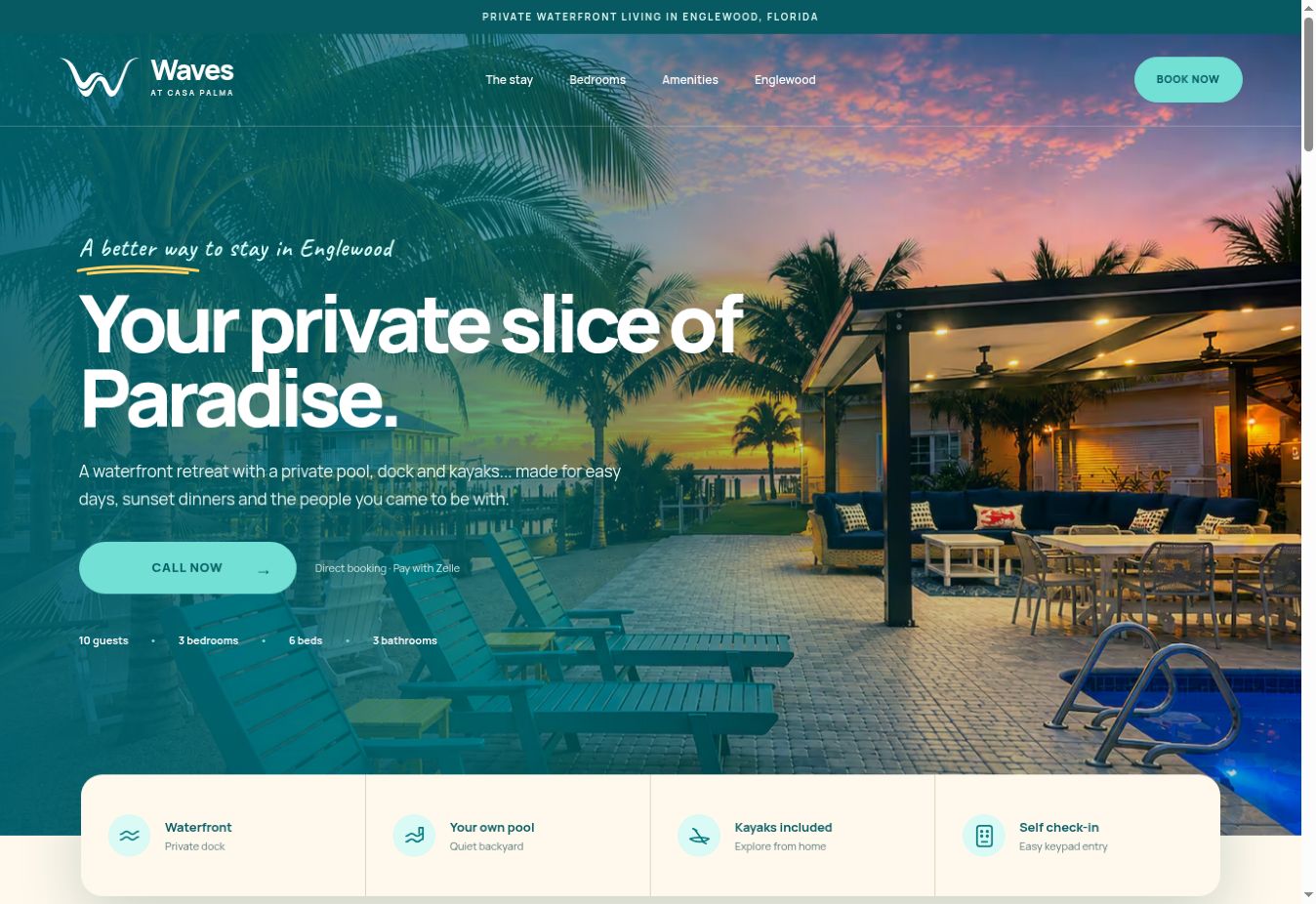
The host owned the home...but not the place where guests experienced its story online.
Waves at Casa Palma is a private waterfront vacation home in Englewood, Florida, designed for groups of up to ten guests. The property combines a private pool, dock, kayaks, outdoor dining, waterfront access, two king primary suites, a bunk room, a sleeper sofa, and the practical details that make a multi-generational or friends' trip easier.
Before the new website, the property's only online presence was a third-party marketplace listing. That arrangement gave travelers a way to discover the home, but it kept the brand inside someone else's interface. The host had limited room to establish a distinct point of view, explain the full experience in a deliberate order, create a memorable domain, or build a direct relationship with a returning guest. Every visitor also remained one click away from a page of competing listings.
Tight Designs turned the property into a destination brand with an online property of its own. The new site leads with the waterfront promise, makes capacity and highlights visible immediately, shows how the home supports different groups, organizes amenities by the way guests use them, explains the Englewood setting, states important house expectations, and closes with an intentionally simple direct-booking path.
The commercial value is control. For a reservation completed directly, the owner does not have to surrender the marketplace commission attached to that transaction. The full direct reservation payment can remain with the owner before applicable taxes, payment costs, cleaning, maintenance, utilities, insurance, and other operating expenses. That distinction is more accurate than saying every dollar is profit, and it still represents a meaningful business advantage.
Brand positioning
Present the home as a private waterfront way to experience Englewood, not simply another card in a marketplace search result.
Property storytelling
Organize capacity, sleeping, amenities, outdoor living, location, and house expectations around the questions guests ask before contacting a host.
Direct conversion
Move a qualified visitor from dates and group size to availability, pricing, rules, and confirmed payment without pretending an automated booking engine exists.
Owned visibility
Create a memorable branded domain that can support referrals, return guests, local search, partnerships, and future marketing beyond a single platform.
A marketplace listing can rent attention. It cannot become the owner's permanent digital asset.
The old presence could show photos and accept platform bookings, but the platform controlled the frame around the property. The project needed to create independence without discarding the useful role marketplaces can still play in traveler discovery.
“The property was bookable online...but its brand, audience, and booking relationship lived on rented ground.”
A third-party listing disappears into a search grid. Its presentation follows the marketplace template, its policies can change, its fee model belongs to the platform, and the guest relationship often begins and ends inside that ecosystem. For a distinctive waterfront home, that is a narrow way to communicate value.
Commission exposure
Reservations made through a marketplace can include host and guest fees. The exact rate varies, but every commission reduces the amount retained from that transaction.
Side-by-side competition
A marketplace makes comparison easy. Even a guest who likes the home is continually shown alternative properties, prices, badges, and prompts.
Template-controlled story
The host can supply photos and facts, but the platform decides the hierarchy, visual language, navigation, and context surrounding the listing.
No owned destination
Referrals and returning guests had no dedicated domain where the property could be remembered, understood, and contacted on its own terms.
The owned website does not require the host to reject every marketplace. Third-party platforms can remain useful discovery channels, particularly for first-time travelers who value familiar review and payment systems. The strategic improvement is optionality. Waves at Casa Palma now has a channel it controls, so a marketplace can support the business without being the entire business.
Let the experience earn attention...then remove uncertainty before the call.
The site is intentionally more than a gallery and less complicated than a large reservation platform. Every section has one job in the progression from desire to qualification to direct contact.
Your private slice of paradise
A sunset waterfront hero, immediate capacity details, private pool, dock, kayaks, and a direct call action make the promise understandable in seconds.
Waterfront days
Morning coffee by the pool, paddling from home, fishing from the dock, outdoor dinner, and quiet time beside the water turn features into a stay guests can picture.
Bedrooms and group planning
Two king primary suites, a bunk room, and a queen sleeper sofa explain how couples, families, and multi-generational groups can share the home.
Amenities by use
Kitchen equipment, indoor and outdoor dining, pool and waterfront features, entertainment, laundry, parking, WiFi, and air conditioning reduce pre-booking questions.
Englewood coastal context
Manasota Key, Englewood Beach, Lemon Bay, and Boca Grande connect the property to the experience visitors are actually traveling to Southwest Florida to enjoy.
Three-step direct booking
Call or text dates and group size, confirm availability, pricing, and house rules, then receive Zelle details after the stay is confirmed.
| Guest question | Website evidence | Friction removed | Next action |
|---|---|---|---|
| “Is this right for our group?” | 10 guests, 3 bedrooms, 6 beds, 3 bathrooms | Capacity is visible before contact | Share dates and group size |
| “Will everyone have enough privacy?” | Two king suites, bunk room, sleeper sofa | Sleeping arrangement is understandable | Confirm the guest mix |
| “What makes the stay special?” | Private pool, dock, kayaks, outdoor TV, fish station, dining | The property competes on experience, not only price | Picture the stay and inquire |
| “Where are we staying?” | Englewood, Lemon Bay, Manasota Key, beach and Boca Grande context | The home becomes part of a destination | Plan a Southwest Florida itinerary |
| “How do we book safely?” | Availability, total, and rules confirmed before payment details | The direct process is stated instead of assumed | Call or text the owner |
A direct reservation can keep the marketplace commission inside the property business.
When a guest books through the property's own process, no third-party marketplace needs to automatically retain its commission from that reservation. The owner can receive the full direct reservation payment and decide how that money supports the home, guest experience, maintenance, and business.
This is not a promise of 100 percent profit. Responsible case-study language has to account for taxes, cleaning, utilities, insurance, maintenance, supplies, and any applicable payment expense. The stronger and more defensible claim is that an owned direct channel can avoid the marketplace commission on qualified direct bookings. Over repeat stays and referrals, that difference can compound.
Ownership also has a relationship value. A guest can remember WavesCasaPalma.com, share it directly, return without searching through a marketplace again, and communicate with the host in a clearer context. The website becomes part of the asset base of the rental business rather than an advertisement that lasts only while someone else's platform keeps it visible.
Let the waterfront setting do the selling...then use design to make it easy to believe.
The finished experience uses deep coastal teal, bright aqua, warm cream, generous white space, rounded cards, and sunset photography. The palette feels connected to water and tropical light without falling into a generic beach-template look.
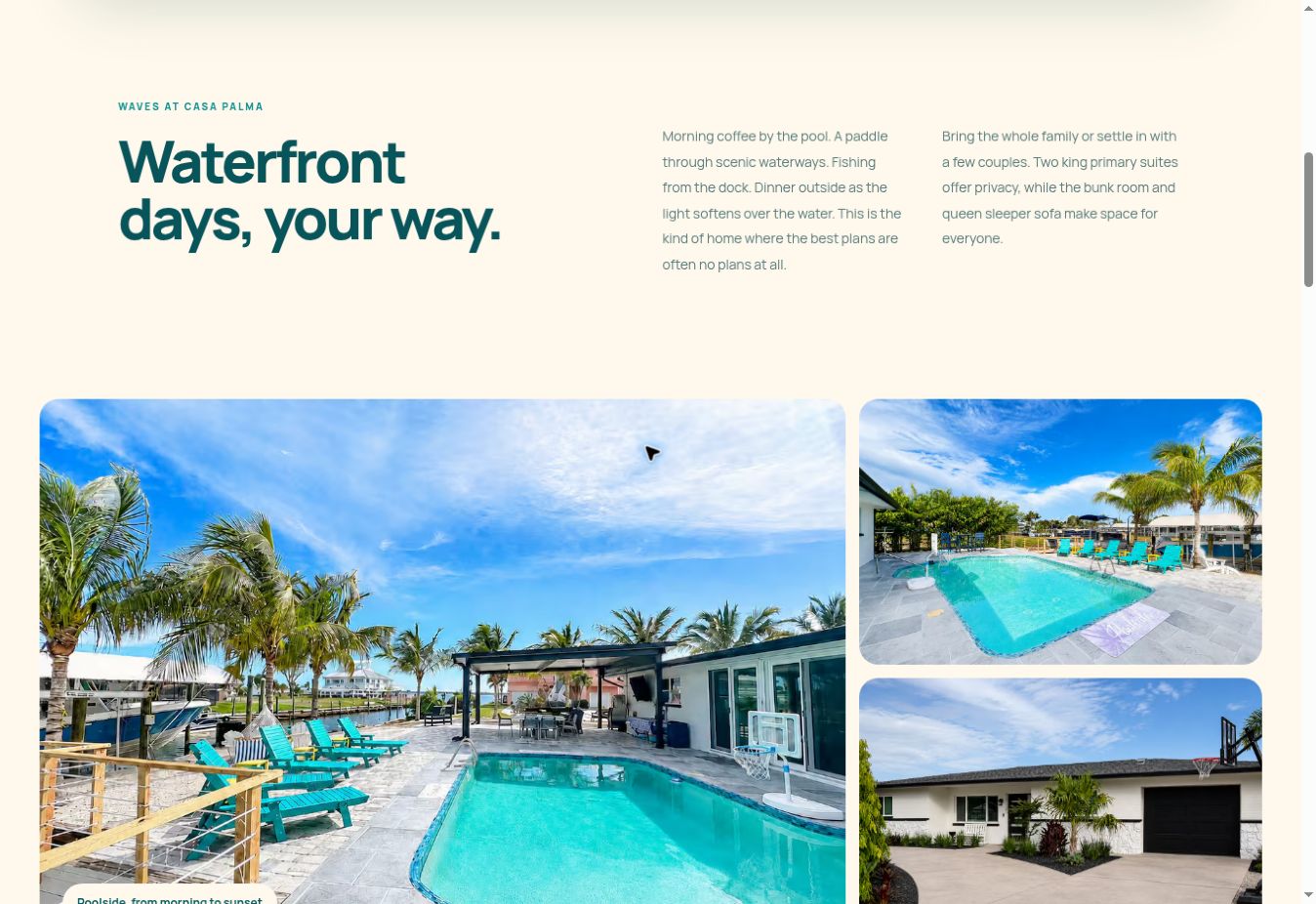
The home is presented as a way to spend the day.
Poolside mornings, paddling from home, fishing from the dock, outdoor meals, and sunset light help a visitor imagine the stay before moving into the room-by-room details.
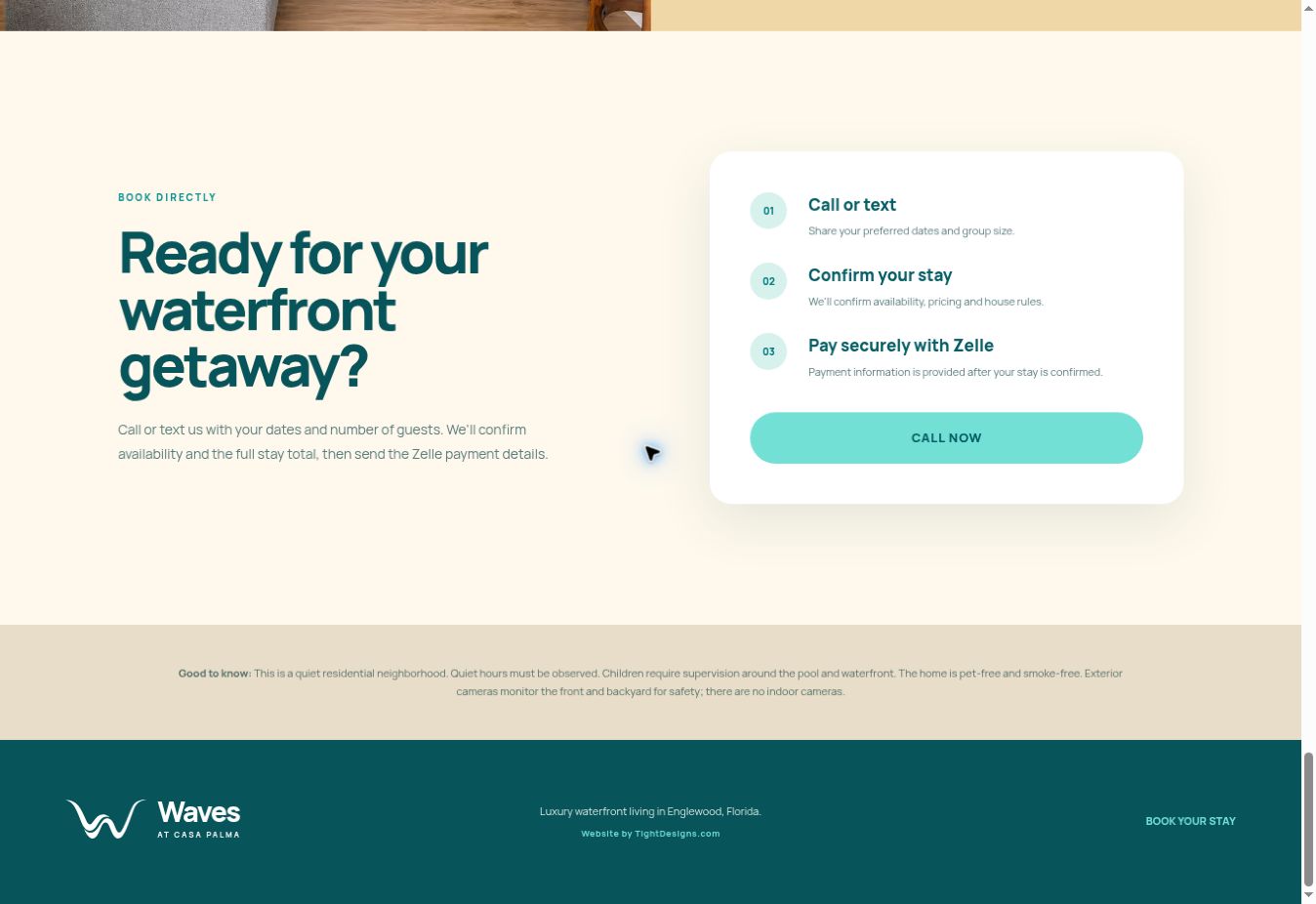
These images are verified captures of the live Waves at Casa Palma website. They document the final property presentation and direct-booking flow as visitors see them, rather than substituting generic vacation-rental mockups.
Turn a platform-dependent listing into a direct relationship guests can trust.
A direct-booking website has to do more than say “save the fees.” It must reduce the uncertainty that the familiar marketplace interface previously handled for the traveler.
“We found a beautiful home, but it looks like every other marketplace result.”
The owned site removes the competing cards and gives the property's private pool, dock, kayaks, sleeping plan, and Englewood setting a focused stage.
A direct guest needs more reassurance, not more hype.
Capacity, sleeping arrangements, amenities, neighborhood expectations, camera disclosure, pet and smoking rules, and the payment sequence appear before the reservation is finalized.
Give the property a branded domain and a complete decision page.
One responsive narrative takes the visitor from aspiration to practical fit, then to a booking conversation with the owner.
The guest stops comparing cards and starts planning this stay.
Dates, group size, privacy, waterfront activities, kitchen needs, parking, local outings, and house rules become the useful next questions.
A qualified guest can book directly...and the owner keeps more of that reservation.
The owner controls the relationship and can avoid a marketplace commission on the direct transaction while still honoring normal business costs and guest responsibilities.
“Keep 100 percent” sounds attractive, but the truthful business benefit is more specific. The direct reservation does not need to lose a percentage to the marketplace. That leaves more gross booking revenue available to operate and improve the property, without pretending every dollar is net income.
A focused one-page experience matches the way this property currently books.
The finished website is not burdened with a complicated reservation system the owner did not ask guests to use. Its structure is built around the real operational path: understand the home, decide whether it fits, then call or text.
Anchored one-page navigation
The stay, bedrooms, amenities, Englewood context, and booking sections remain easy to reach without fragmenting a focused property story across thin pages.
Responsive presentation
Large photography, type hierarchy, feature cards, content grids, and calls to action adapt so guests can evaluate the property from the phone they are likely to use for travel planning.
Click-to-call conversion
Booking actions use a direct telephone link. The page consistently supports the same next step instead of dividing attention among several incomplete forms or checkout choices.
Transparent confirmation flow
The website explains that availability, the full stay total, and house rules are confirmed before Zelle payment details are supplied. That sequence creates a clearer expectation for both guest and owner.
The technology does not pretend to be more automated than the business process.
- One memorable owner-controlled domain for referrals, returning guests, search, and direct promotion
- Single H1 focused on the private waterfront experience rather than a list of rental keywords
- Descriptive title and meta description naming an Englewood waterfront vacation home
- Persistent direct-booking actions connected to the owner's public call path
- Immediate guest, bedroom, bed, and bathroom details in the opening experience
- Sleeping configuration for two king suites, bunk room, and queen sleeper sofa
- Amenities organized around waterfront living, cooking, dining, entertainment, comfort, and logistics
- House expectations covering quiet hours, child supervision, pets, smoking, and exterior cameras
- Three-step booking sequence that separates inquiry, confirmation, and payment
- Tight Designs credit connected back to the agency responsible for the website
Englewood is not a keyword added after the design. It is part of the reason to stay.
The page connects the house to waterfront life and nearby coastal places while keeping the property itself at the center of the decision.
Property fit
- Up to 10 guests
- 3 bedrooms, 6 beds, and 3 bathrooms
- Two king primary suites with ensuite bathrooms
- Bunk room and queen sleeper sofa for flexible groups
Waterfront experience
- Private dock and kayaks
- Private pool and outdoor television
- Fish-cleaning station and barbecue
- Indoor and outdoor dining beside the water
Everyday comfort
- Fast WiFi, television, central air conditioning, and laundry
- Driveway parking and keypad self check-in
- Equipped kitchen with coffee and specialty appliances
- Clear quiet-neighborhood expectations
Local orientation
- Englewood and Lemon Bay identity
- Manasota Key and Englewood Beach context
- Boca Grande as a nearby coastal reference
- Water-based activities beginning at the home
An owned domain gives the property a place to build branded searches, local relevance, links, repeat visits, and useful content over time. It does not guarantee rankings simply because the site exists. Continued search work should include indexation checks, structured data, local and travel partnerships, first-party content, performance improvements, and measurement of the queries that actually introduce qualified guests.
The first result is ownership: the property now has a direct digital address and booking path.
No reservation or revenue numbers are invented here. The defensible before-and-after is structural, commercial, and visible on the live website.
Waves at Casa Palma no longer depends on a third-party listing as its only online property. The owner can still use marketplaces for discovery while directing referrals, repeat guests, and appropriate prospects to a branded experience the owner controls.
A new direct channel is measurable. Its long-term value needs booking records.
No increase in traffic, occupancy, direct bookings, repeat stays, booking revenue, or net income is claimed. Those results require a comparison period and access to first-party inquiry and reservation data. Avoided commission should be calculated from each direct booking and the marketplace rate that would otherwise have applied, not from a generic industry percentage.
One third-party online listing
The property lived inside a marketplace template, beside competitors, under platform rules and fees, without a permanent branded destination of its own.
An owned direct-booking property
WavesCasaPalma.com presents the real stay, local setting, capacity, amenities, expectations, and direct reservation process without placing another rental beside it.
What Tight Designs completed.
The project combined brand direction, property storytelling, responsive design, local context, and a direct conversion path into one focused owner-controlled site.
- Vacation-rental positioning and direct-booking message
- Waves at Casa Palma visual identity presentation
- Waterfront hero with guest-capacity proof
- Responsive anchored navigation and mobile behavior
- Property-experience narrative and photography layout
- Bedroom and sleeping-arrangement presentation
- Kitchen, comfort, waterfront, and logistics amenities
- Englewood, Lemon Bay, Manasota Key, and Boca Grande context
- Quiet-neighborhood, child-safety, pet, smoking, and camera disclosures
- Three-step call, confirmation, and Zelle booking explanation
- Click-to-call actions throughout the visitor journey
- Owner-controlled domain that supports direct referrals and repeat guests
Owning the website changes the economics and the relationship.
A marketplace is a channel, not an asset the host controls.
Platforms can produce discovery and trust, but the listing remains subject to their template, competitors, policies, fees, and audience ownership. A dedicated domain gives the property a durable home base.
Direct booking must earn confidence.
Removing a platform does not remove the guest's questions. Capacity, rooms, amenities, setting, house rules, confirmation steps, and payment expectations need to become more explicit.
The commission story should stay mathematically honest.
A direct reservation can avoid the marketplace's percentage. It does not erase taxes or operating expenses. Precision makes the business case stronger, not weaker.
Repeat guests are more valuable when they can find the property again.
A memorable name and domain allow referrals and returning visitors to bypass a new marketplace search, reducing the chance that a competitor captures a relationship the property already earned.
Questions about the Waves at Casa Palma website
What did Tight Designs build for Waves at Casa Palma?
Tight Designs created an owner-controlled vacation-rental website for a private waterfront home in Englewood, Florida. The responsive one-page experience presents the property, sleeping arrangements, amenities, local setting, house expectations, and a direct call-or-text booking path on the property's own domain.
Why does a vacation rental need its own website if it is already listed on a marketplace?
A marketplace can be valuable for discovery, reviews, and traveler familiarity, but the host does not control the platform, the surrounding competitors, the fee structure, or the long-term guest relationship. An owned website gives the property a permanent branded destination and allows qualified guests to contact the owner directly when that booking method is appropriate.
Does a direct booking let the owner keep 100 percent of the revenue?
A direct reservation can avoid the marketplace commission that would otherwise be deducted from that booking, so the full direct reservation payment can reach the owner instead of a platform automatically retaining a percentage. That is not the same as 100 percent profit. Taxes, payment costs when applicable, cleaning, maintenance, insurance, utilities, and other operating expenses still exist.
How does the Waves at Casa Palma website handle reservations?
The website uses a simple three-step path. A guest calls or texts with preferred dates and group size, the owner confirms availability, pricing, and house rules, and payment information is provided after the stay is confirmed. The current experience uses Zelle rather than claiming to provide an automated booking engine.
What local information does the website include?
The page positions the home in Englewood and connects the stay to Manasota Key, Englewood Beach, Lemon Bay, and Boca Grande. It explains the waterfront experience through the private dock, kayaks, pool, outdoor living, and nearby coastal setting instead of treating the property as an interchangeable Florida rental.
Does this case study claim more bookings or revenue after launch?
No. The verified outcomes are the live owned domain, complete property presentation, direct inquiry path, responsive experience, local destination context, and clear three-step booking process. Booking volume, avoided commissions, occupancy, repeat-guest rate, and revenue should only be reported after first-party reservation and financial records establish a defensible baseline.