Knowing what to put on a business card sounds simple until you actually have to make decisions about space, priority, and what helps someone take the next step. Most business cards fail for one of two reasons… they either try to say too much, or they leave out the details that actually matter. A good business card is not just a contact slip. It is a tiny piece of sales collateral that should make your business easier to remember, easier to contact, and easier to trust.
Start with the real job of the card
Before deciding what goes on the card, think about what the card is supposed to do. Is it mainly for networking? Is it used on service calls? Is it handed out after estimates? Is it meant to drive people to a website, booking form, or offer page? The right content depends on the role the card plays in your sales process.
That is where many people go wrong. They treat every card the same, even though different businesses use cards in different ways. A realtor, plumber, med spa, attorney, and restaurant owner may all need a business card, but the right information mix is not identical for each one. The best setup is the one that makes the next step easy for the person receiving it.
The core information most business cards should include
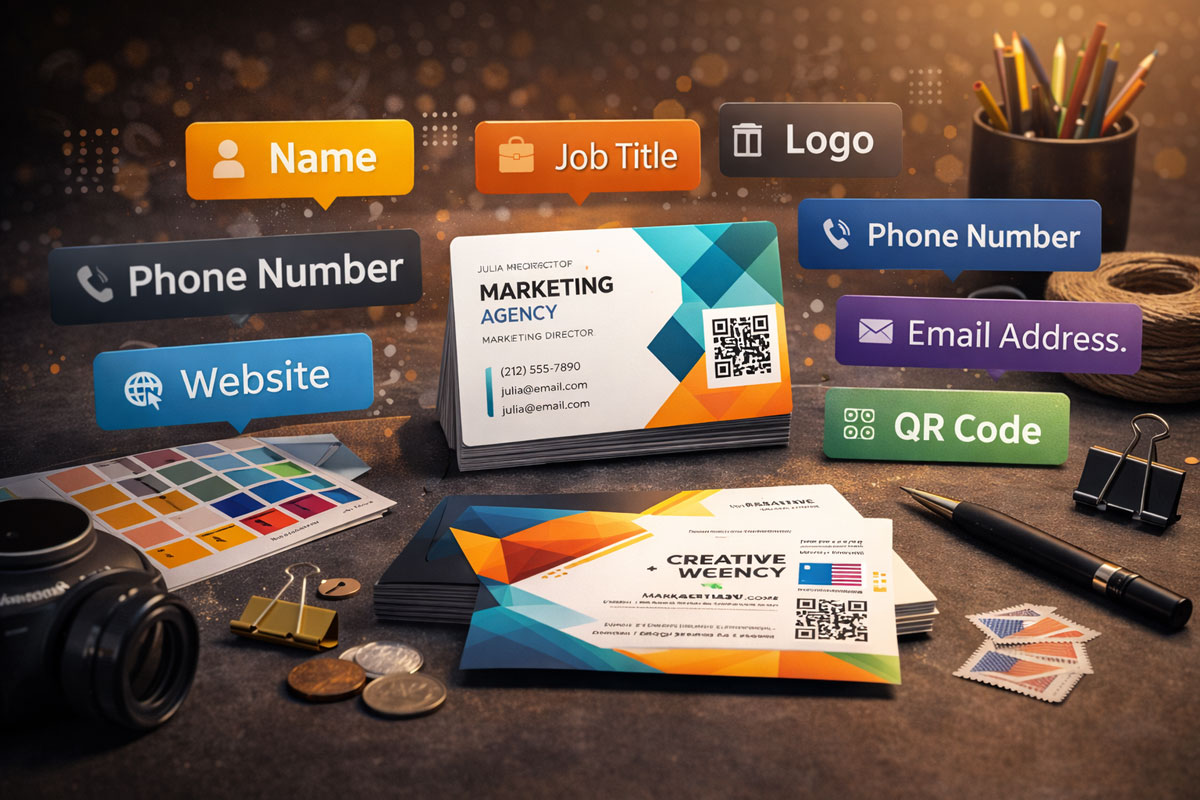
For most businesses, there is a short list of essentials that belongs on the card. These are the pieces that help people know who you are, what business they are dealing with, and how to reach you without friction.
- Name: The actual person people are likely to remember or ask for
- Business name: The brand people need to associate with the service
- Title or role: Helpful when it adds clarity, authority, or context
- Phone number: Usually one of the most important action points
- Email address: Useful if customers or referral partners prefer email
- Website: Important when the site helps validate the business or continue the conversation
That is the baseline. From there, the question becomes whether anything else deserves the limited space. Not everything does.
What deserves space… and what usually does not
A business card is small, which means every line has to earn its place. If a detail does not help someone understand, remember, contact, or act, it may not belong. Too many cards become cluttered because the owner tries to include everything instead of prioritizing what matters most.
Here is a useful filter… if someone sees your card for three seconds, what do they absolutely need to take away? Usually that is your name, brand, contact path, and a clear sense of what you do. Anything beyond that should support the main goal, not compete with it.
- Good additions when relevant: tagline, short service descriptor, QR code, social handle, appointment reminder info, or a call to action
- Often unnecessary: multiple phone numbers, too many email addresses, long service lists, full paragraphs, or every social platform you own
- Use caution with: tiny text, legal clutter, and details that only matter internally to you
What to put on the front of the card
The front of the card should usually handle the fastest and most important recognition tasks. That means brand, person, role, and primary contact path. The front is where clarity matters most. If the front feels crowded or confusing, the whole card feels weaker.
For many businesses, the front should include the logo, business name, person’s name, title if useful, phone number, and website. In some cases, the title can be less important than a short service descriptor. For example, “Owner” may be less useful than “Drain Cleaning and Repipe Specialist” if the goal is to make the offer more memorable.
If you need help balancing layout and readability, our business card design services page explains how we approach structure, hierarchy, and visual decision-making.
What to put on the back of the card
The back of the card is where strategy can make the piece much more useful. Too many business cards leave the back blank when that space could be helping the business. The back can support conversion, reinforce branding, or make the card more practical in the real world.
Good uses for the back include a QR code, a short call to action, a list of top services, a coupon or first-visit offer, appointment reminder space, review prompt, or a few trust-building points. The key is not to overload it. The back should support the front, not turn the card into a flyer.
- Great back-of-card options: Scan to book, top 3 services, short offer, save our contact, review us, or next-step instruction
- Best for service businesses: service categories, emergency availability note, or referral-friendly message
- Best for visual businesses: QR code to portfolio, gallery, before-and-after page, or social proof page
If you are considering adding a scannable destination, our Business Cards with QR Codes page covers when that makes sense and what to watch out for.
Should you include your address?
Sometimes yes… sometimes no. If you run a storefront, office, clinic, or location people actually visit, the address may be helpful. But if you are a service-area business, home-based business, or company that mainly serves customers at their location, printing the address may not help much and may just eat up space.
This is one of those details that should be decided strategically, not automatically. If the address helps customers arrive, trust you, or understand that you have a physical location, include it. If it adds little value and pushes more important information into smaller text, leave it off.
Should you include social media?
Only if it helps. Social media handles can be useful when your audience actively checks your work there, such as for tattoo artists, photographers, salons, restaurants, designers, or other visually driven businesses. But adding every platform just because you have them usually weakens the card.
The better approach is to include only the one that matters most, or use a QR code that sends people to a page where they can choose what they want to explore next. That keeps the card cleaner and avoids making the design feel crowded with icons.
Do taglines and service descriptions belong?
Often, yes. In fact, this is one of the most underused areas of business card messaging. A short, clear service description can help the card work much harder. If your business name does not immediately explain what you do, a line of clarification can improve memorability and referrals.
For example, a business named after a founder may need a service line more than a business with a descriptive brand name. “Tight Designs” benefits from context like printing, design, websites, or signage because the name alone does not explain the full offer to every new person instantly.
The important thing is to keep it short. A business card is not the place for a full elevator pitch. It is the place for a fast positioning cue.
Should you add a call to action?
Yes, when there is a clear next step worth encouraging. A call to action can turn a passive card into a more useful response tool. It can be as simple as “Call for a quote,” “Scan to book,” “Visit our gallery,” or “Save our contact.”
This works especially well when the card is meant to continue the interaction after the handoff. If you want help with phrasing, read How to Write a Business Card Call to Action.
Common mistakes people make when deciding what to include
Most bad content choices come from fear… fear of leaving something out, fear that people will not understand the business, or fear that the card has to do everything at once. That leads to clutter, weak hierarchy, and a card that feels harder to use.
- Trying to include too much: More information does not always create more value
- Leaving out what matters most: Sometimes the phone number or website is visually buried
- Using tiny text to fit everything: This hurts readability and trust
- Adding every service: A short priority list usually works better
- Ignoring the back: Valuable space gets wasted
- Forgetting the next step: The card gives contact info but does not guide action
For a deeper look at weak execution, visit Business Card Mistakes to Avoid.
How to decide what belongs for your kind of business
The best business cards are built around context. A home service business may benefit from strong phone visibility and a short list of services. A creative business may benefit from a portfolio QR code. A medical office may need clean contact information plus an appointment-focused back. A referral-driven business may want messaging that makes it easier for someone to pass the card along confidently.
That is why there is no universal checklist that works perfectly for everyone. The right content is the content that supports the card’s real job, fits the brand, and helps the next step happen with less friction.
Frequently Asked Questions
What is the most important thing to put on a business card?
The most important elements are usually your name, business name, primary contact method, and a clear way for people to understand what you do.
Should I put all my services on my business card?
Usually no. A short list of priority services is often better than trying to cram everything onto the card.
Do I need to include my website?
In most cases, yes… especially if your website helps validate the business, answer questions, or move people toward booking, contacting, or requesting a quote.
Should I put a QR code on my business card?
It can be a very smart addition when it reduces friction and sends people somewhere useful. Just make sure it is designed properly for print.
Is it okay to leave the back blank?
It is okay, but often not ideal. The back can be used strategically for calls to action, QR codes, offers, or service highlights.
Need Help?
If you are not sure what belongs on your business card, Tight Designs can help you make those decisions strategically instead of guessing. Take a look at our main Business Cards page for the full detail on what is available to you, or contact us and we will help you build a card