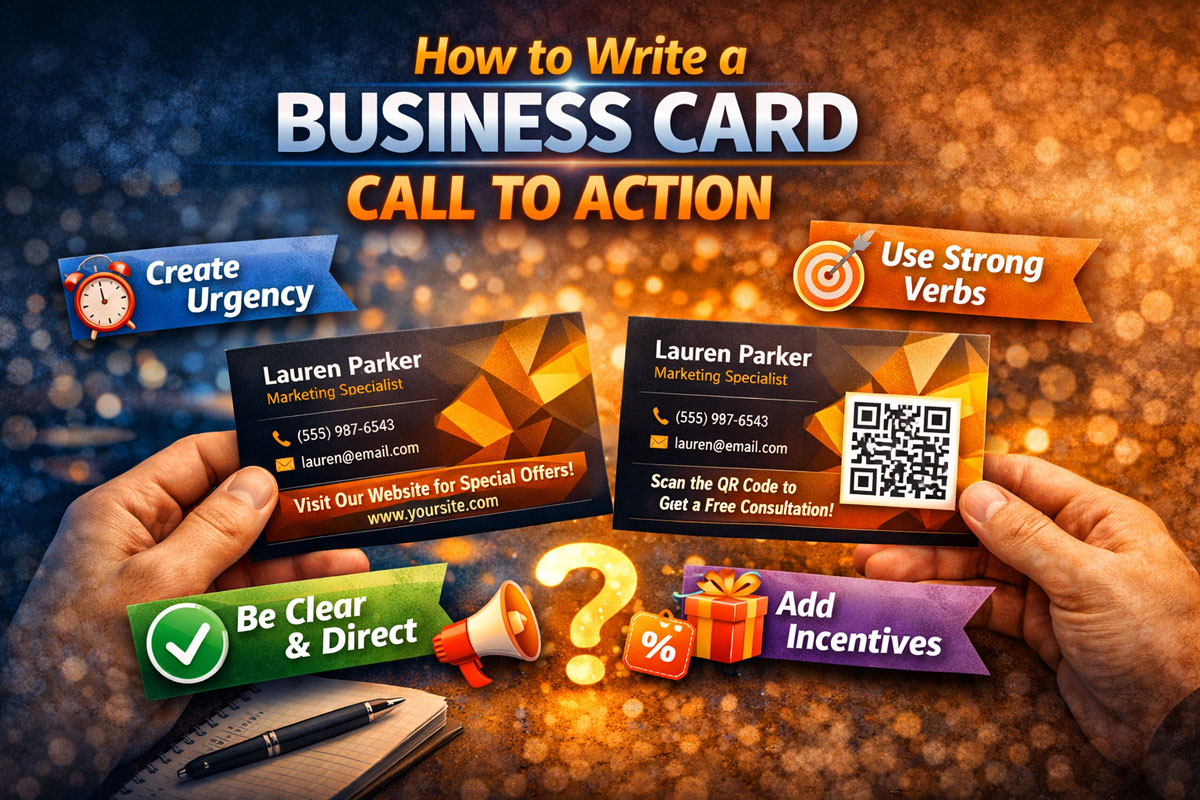
Most business cards stop at contact information. That is useful, but it leaves a lot on the table. A call to action gives the card direction. It tells people what to do next instead of hoping they figure it out on their own. For some businesses, that next step might be calling for a quote. For others, it might be scanning a QR code, booking an appointment, viewing a portfolio, or saving contact information. A good business card call to action is short, clear, and tied to how the business actually gets customers.
Why a business card needs a call to action
A business card may be small, but it is still a marketing piece. That means it should do more than just exist. It should help move the interaction forward. Without a call to action, the card can still function as a reference tool, but it may not give the person enough of a reason to take the next step.
This matters because most people are busy, distracted, or only half-committed in the moment they receive the card. If the next action is not obvious, they may put it away and forget about it. A simple call to action reduces that friction by making the next move easier and more immediate.
What a business card call to action should do
The best call to action on a business card is not the one that sounds the most clever. It is the one that makes sense for the business and the situation. A good CTA should match the stage of the relationship, the way the business sells, and what the recipient is most likely willing to do next.
- Make the next step obvious: Tell people what action to take
- Reduce friction: Do not make the action feel complicated
- Fit the card’s purpose: A networking card may need a different CTA than a service call leave-behind
- Support the actual sales process: The CTA should lead toward a meaningful business outcome
If the card is meant to help someone remember you later, the CTA may be subtle. If the card is meant to generate direct action, the CTA can be more explicit.
Examples of strong call to action styles
Different businesses need different types of CTAs. The right wording depends on whether the goal is to create a phone call, a booking, a scan, a website visit, a quote request, or a referral-friendly follow-up.
- Call-focused: Call for a quote… Call to schedule… Call for same-day service
- Scan-focused: Scan to book… Scan to view our work… Scan for pricing
- Website-focused: Visit our gallery… See our services… View recent projects
- Referral-focused: Keep this card handy… Share with a friend… Save our contact for later
- Offer-focused: Ask about our first-time offer… Scan for current specials
Notice that none of these need to be long. A good CTA on a business card usually works best when it is brief and easy to process in one glance.
Match the CTA to the kind of business you run
The strongest call to action depends heavily on the business model. A home service company may want to push phone calls. A med spa may want appointment booking. A designer may want portfolio views. A realtor may want people to save contact information or visit listings. A restaurant may want a menu scan or online ordering action.
This is where a lot of cards go wrong. They use generic language that does not match how the business actually wins customers. If your business closes deals by phone, the CTA should probably support calling. If your business converts better through a landing page or scheduler, the CTA should point there instead.
If you are still working out the role of the card itself, read what to put on a business card.
Keep it short enough to fit naturally
A business card does not have space for a full pitch. The CTA has to work within the reality of the layout. That means it should be short, direct, and visually easy to place without crowding the design.
In many cases, the best CTA is only two to five words long. That is enough to create clarity without forcing the card to carry too much copy. If the CTA is too long, it can start fighting the rest of the hierarchy and make the card feel cluttered.
- Good length: Scan to book… Call for a quote… View our work
- Usually too long: Please visit our website to learn more about all our services and current promotions
Placement matters as much as wording
A CTA can be well written and still underperform if it is buried in the wrong place. On a business card, placement affects whether people even notice the instruction. The CTA should feel connected to the part of the card that supports it.
For example, if the call to action is tied to a QR code, it should live close to the code. If the CTA is about calling, it may make sense near the phone number. If the CTA is a back-of-card instruction, it should be positioned clearly and not mixed into unrelated details.
Good layout makes the CTA feel natural instead of forced. If you need help with that, our business card design services can help balance messaging and structure the right way.
Use CTAs that lower resistance
A strong CTA does not always need to sound aggressive. In many cases, lower-resistance wording works better on a business card because the person is still early in the decision process. They may not be ready to commit, but they may be willing to take a smaller step.
That is why a card CTA often performs better when it invites rather than pressures. “Scan to view our work” can be easier to accept than a hard push. “Call for a quote” works when someone is already solution-aware. “Save our contact” can be useful when the goal is simply to stay available for later.
What makes a CTA weak on a business card
Weak CTAs are usually vague, generic, or disconnected from what the person actually wants. A line like “Learn more” is not useless, but it is weaker than something more specific. The same goes for vague instructions that do not explain why someone should care.
- Too vague: Learn more… Click here… Get started
- Too generic: Contact us today… Visit our website
- Too long: Long sentences that feel more like ad copy than a card instruction
- Too disconnected: A CTA that does not match the business model or next logical step
The best CTAs create a small but clear bridge between the card and the desired action.
QR codes can make the CTA more effective
One of the easiest ways to strengthen a business card CTA is to pair it with a QR code. This works especially well when the next step is digital. A CTA like “Scan to book” or “Scan to view our work” removes the friction of typing a long URL and gives the card a cleaner path to action.
The key is making sure the QR code is actually designed for print and points somewhere useful. If the code is too small, too low contrast, or tied to a bad destination, the CTA loses power. If done correctly, though, QR codes can make a business card much more actionable.
For more on that, see our business cards with QR codes page.
Examples by business type
Sometimes it helps to think in practical examples rather than theory.
- Plumber: Call for a quote… Scan for services
- Realtor: Scan to view listings… Save my contact
- Med spa: Scan to book… Ask about current specials
- Designer: View our work… Scan for portfolio
- Restaurant: Scan our menu… Order online
- Contractor: Call for an estimate… See recent projects
Each of these works because it points toward a next step that feels natural for the business.
Do not let the CTA overpower the rest of the card
Even though the CTA matters, it should not hijack the entire design unless the card is built around a very specific action. In most cases, the CTA should support the card, not dominate it. The card still needs to identify the business, present the brand well, and make the main contact path clear.
That balance is important. A card that screams the CTA but weakens the overall professionalism may not perform as well as one that integrates the CTA more cleanly.
Common mistakes to avoid
- Using no CTA at all: The card gives no guidance about what to do next
- Making it too vague: The instruction is too weak to create action
- Making it too long: The wording crowds the design
- Pointing to the wrong destination: The CTA leads somewhere unhelpful or irrelevant
- Forgetting layout: The CTA exists, but it is buried or disconnected from the design
For a broader look at weak execution, read business card mistakes to avoid.
Frequently Asked Questions
Does a business card really need a call to action?
Not every card needs a hard sell, but most cards benefit from some kind of next-step guidance. Even a subtle CTA can make the card more useful.
What is a good call to action for a business card?
A good CTA is short, clear, and matched to how the business gets customers. Examples include Call for a quote, Scan to book, View our work, or Save our contact.
Should the CTA go on the front or back of the card?
It depends on the layout. Many CTAs work well on the back, especially when paired with a QR code, but the best placement is wherever it feels clear and natural.
Can a QR code replace the call to action?
Not completely. The QR code works better when it has a short CTA telling people what happens when they scan it.
What makes a CTA weak on a business card?
Usually vagueness, poor placement, too much length, or a mismatch between the CTA and the business’s real sales process.
Need Help?
If you want a business card that does more than just share contact information, Tight Designs can help you build in the right message, the right next step, and the right design support around it. You can explore our business card services or contact us to get started.