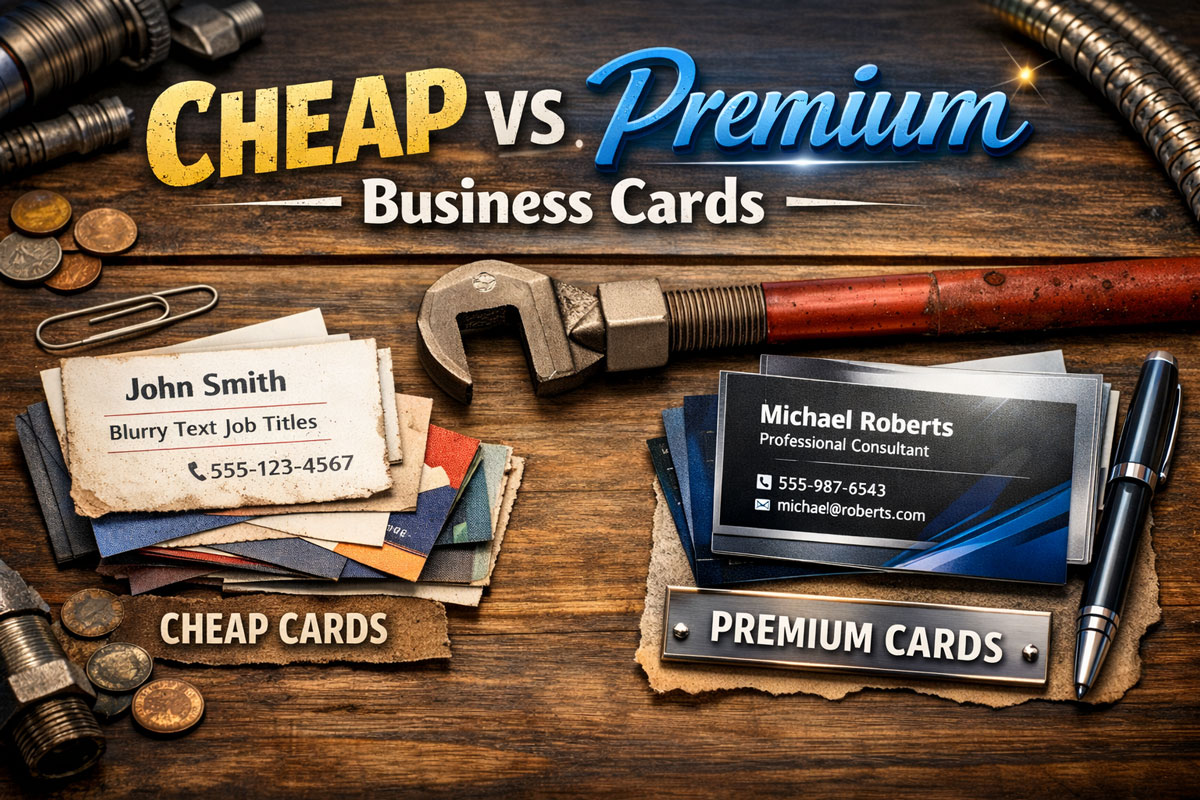
Cheap and premium business cards are not just different price points… they usually signal different priorities. One is often built around affordability and volume. The other is built around impression, feel, and presentation. Neither is automatically right or wrong. The better choice depends on what role the card plays in your business, how often you hand it out, what kind of customer you are trying to attract, and whether the card is supposed to feel practical, impressive, or both.
Cheap vs premium business cards at a glance
| Factor | Cheap Business Cards | Premium Business Cards |
|---|---|---|
| Main advantage | Lower cost and easier high-volume ordering | Stronger first impression and better perceived quality |
| Best for | Everyday handouts, route-based teams, large distribution | High-ticket services, luxury brands, client-facing presentation |
| Typical feel | More basic and functional | Heavier, cleaner, more polished |
| Print options | Usually more limited | Often includes thicker stocks and upgraded finishes |
| Risk | Can feel forgettable or cheap if pushed too far | Can cost more than the situation justifies |
| Best decision driver | Quantity and practicality | Brand perception and customer expectations |
What people usually mean by cheap vs premium
Cheap business cards usually mean lower-cost cards designed to keep ordering simple and affordable. That often involves more basic stocks, more standard finishes, and fewer specialty upgrades. Premium business cards usually mean thicker, better-feeling cards with upgraded presentation… sometimes through stock, finish, texture, coating, or simply cleaner overall print quality.
The important thing is this… cheap does not always mean bad, and premium does not always mean smart. A lower-cost card can still be clean, effective, and appropriate. A premium card can still be wasted money if it does not match the business model or how the card is used.
When cheap business cards make the most sense
Cheap business cards make sense when the card needs to be distributed often and the business benefits more from volume than from luxury feel. This is common for field teams, route-based service companies, canvassing, networking at scale, trade shows, community distribution, and businesses that go through cards quickly.
If your team hands out cards every day, leaves them behind on service calls, includes them in invoices, or keeps stacks in trucks, lower-cost cards may be the smarter operational choice. In that case, the card needs to be professional enough to represent the business well, but it does not necessarily need to feel luxurious.
- Good fit for: plumbers, HVAC companies, electricians, roofers, cleaning companies, pest control, movers, and other high-frequency local service businesses
- Strong advantage: easier to keep plenty on hand without overthinking every handoff
- Main goal: coverage, convenience, and everyday usability
When premium business cards make the most sense
Premium business cards make more sense when first impression carries extra weight. That is often true for businesses selling higher-ticket services, relationship-based expertise, luxury positioning, aesthetic appeal, or a more curated brand experience. In those cases, the card is not just an information tool… it is part of the sales experience.
A premium card can help support perception when the customer is judging quality, professionalism, taste, or attention to detail. That can matter for luxury real estate, med spas, designers, attorneys, consultants, upscale home services, and brands where presentation influences trust or willingness to pay.
- Good fit for: premium service providers, consultants, realtors, designers, med spas, high-end contractors, and boutique brands
- Strong advantage: stronger tactile impression and more perceived brand value
- Main goal: credibility, polish, and memorability
Side-by-side comparison of the real tradeoffs
| Decision Area | Cheap Cards Usually Win When… | Premium Cards Usually Win When… |
|---|---|---|
| Volume matters most | You need a lot of cards in many hands | Distribution is selective and intentional |
| Brand perception matters most | The business is practical and straightforward | The brand needs to feel elevated or high-trust |
| Budget pressure is real | You need to control costs tightly | You can justify higher spend per interaction |
| Referral use is common | Useful if the card still stays readable and clear | Useful if the card also needs to impress when passed along |
| Reorders happen often | Cheaper cards are easier to replenish regularly | Premium works better if the design stays stable for longer |
Cheap is not the same thing as ineffective
This is where people get confused. A cheap business card can still work very well if the layout is strong, the information is clear, and the print quality is decent for the purpose. Many businesses do not need luxury finishes to get results. They need a card that is readable, durable enough, easy to reorder, and easy to hand out without hesitation.
In fact, for some businesses, over-investing in premium cards can create the wrong behavior. If the cards feel too precious, the team may become stingy with them. That defeats the purpose if the card is supposed to support everyday distribution and referral flow.
Premium is not just about showing off
On the other side, premium is not automatically vanity. Sometimes it is a strategic investment. If your business depends on perception, detail, trust, and positioning, a heavier stock or more refined finish can reinforce the message that your business is established and intentional.
That matters when the customer is deciding whether you feel worth the higher price you charge. In those cases, the card becomes part of your overall brand experience, much like your website, signage, proposal, or office presentation.
How customer type should influence the decision
The right answer often becomes clearer when you think about the customer. Are they mainly price-driven, convenience-driven, trust-driven, or image-driven? Are you meeting them in practical situations or higher-end consultative ones? A card should fit the expectation of the buyer.
If the customer mainly wants reliable service and an easy phone number to call later, a clean lower-cost card may be enough. If the customer is evaluating your sophistication, taste, or premium positioning, a more upgraded card may help support that impression. The point is not to spend more automatically. The point is to spend where it strengthens the sale.
How the card is used should influence the decision too
Context matters just as much as brand. Is the card handed out on job sites, mailed in folders, set on front desks, passed through referral chains, or presented during polished client meetings? Cards that live hard lives in trucks, tool bags, glove boxes, and drawers may benefit more from practical value than from premium flourishes.
Cards handed out in more selective, polished, or consultative settings may gain more from better stock and finish. The better the context supports presentation, the more premium cards may pay off.
A better question than cheap or premium
Instead of asking which one is better in general, ask this… what does this card need to do for my business? If the answer is widespread daily distribution, then cheaper but still well-designed cards may be the right move. If the answer is to leave a stronger impression in fewer, more valuable interactions, then premium may make more sense.
That question usually leads to a better decision than simply comparing price tags.
Common mistakes people make in this comparison
- Assuming cheap means bad: A simple card can still perform very well when built correctly
- Assuming premium always converts better: Sometimes it does not match the use case
- Ignoring distribution habits: If the team goes through cards fast, premium may not scale well
- Ignoring brand expectations: If the brand should feel elevated, cutting too many corners can hurt
- Comparing only by unit price: The real question is return, not just cost
What we usually recommend
For many businesses, the smartest answer is not the cheapest possible card or the fanciest possible card. It is the most appropriate card. That may mean a clean, professional everyday card for broad distribution, or a more elevated card for owner use, sales use, or high-value client interactions. Some businesses even benefit from using both strategically.
If you are deciding between visual finishes as part of that choice, you may also want to read matte vs gloss business cards. If you need help matching the card type to the way your business actually operates, our business card design services can help.
Frequently Asked Questions
Are premium business cards worth it?
They can be… especially when brand perception, trust, and presentation meaningfully influence the sale. They are not automatically worth it for every business.
Do cheap business cards hurt your image?
They can if they feel sloppy, flimsy, or poorly designed. But a lower-cost card can still work well if it is clear, clean, and appropriate for the business.
What is better for service businesses?
For many service businesses, practical professional cards often make the most sense. But premium can still be a smart move for higher-ticket or more brand-sensitive service categories.
Should I order premium cards if I hand them out all the time?
Not always. If you go through cards quickly, a more cost-efficient option may be better. In some cases, businesses use standard cards for broad distribution and premium cards for select interactions.
Can I mix affordability and quality?
Yes. In many cases, the best option is a clean, professional mid-level setup that feels solid without going overboard.
Need Help?
If you are trying to decide whether cheap or premium business cards make more sense for your brand, Tight Designs can help you weigh the tradeoffs based on how your business actually markets, sells, and follows up. You can explore our business card services or contact us to get started.