
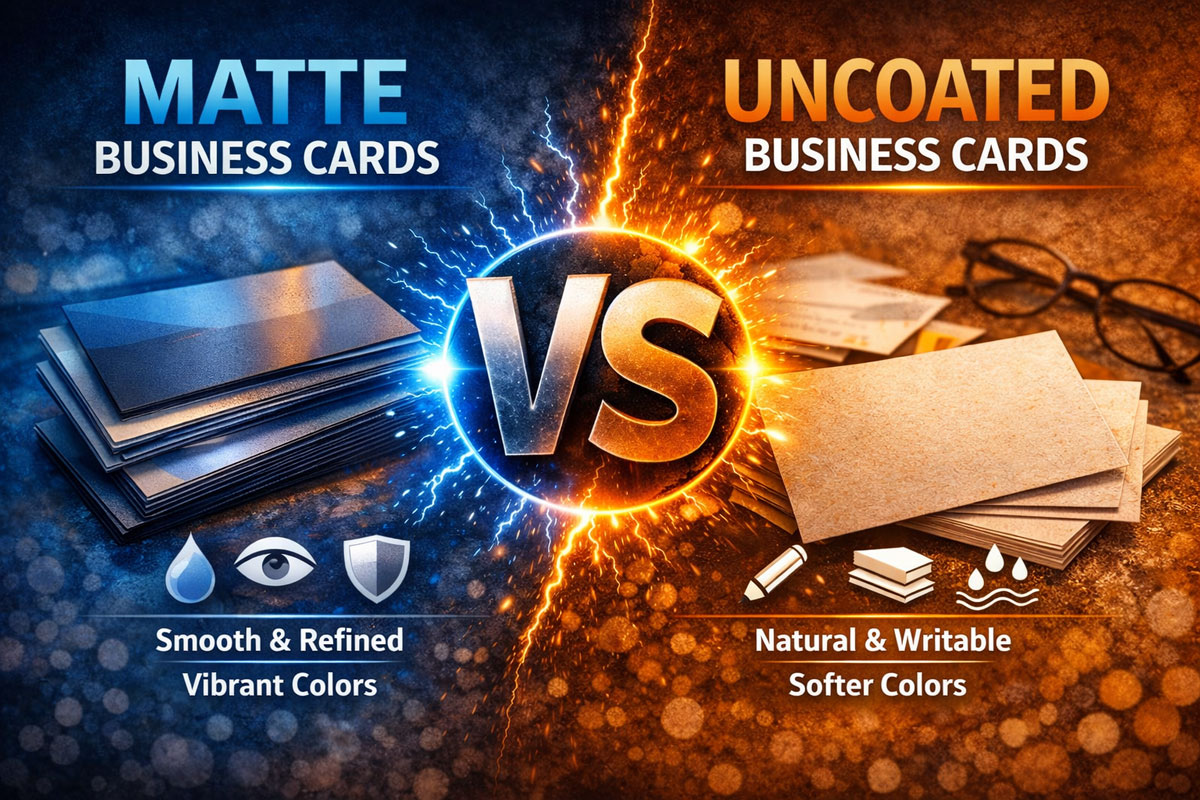
If you have ever shopped for business cards, postcards, flyers, or brochures, you have probably seen terms like matte, uncoated, no coating, matte finish, matte coated stock, or matte lamination and wondered what they actually mean.
The confusion is understandable. In everyday language, people often use matte to mean “not shiny.” In commercial printing, that is only part of the story.
A printed piece can look flat and non-glossy for several different reasons. Some papers are naturally uncoated. Some are coated with a dull finish. Some have a matte film applied after printing. Those are not the same thing, even if they can appear similar at first glance.
This guide explains the difference between matte and uncoated, then breaks down the major types of “matte” you may run into when ordering printed products.
The First Principle … Start With What Is Actually Being Described
Before comparing finishes, it helps to separate three different things that people often lump together:
- The paper itself
This is the base stock. It may be coated or uncoated before anything is printed. - The printing process
Ink or toner is applied to the sheet. How the surface receives that ink affects sharpness, color, and feel. - The final finish
After printing, some products receive an added finish such as aqueous coating, UV coating, or lamination.
Most confusion happens because the word matte can refer to either the paper surface or the final finish, while uncoated refers specifically to the lack of a coating on the paper surface.
That means matte and uncoated are not opposite categories in the simple way many people assume.
What Is Uncoated Paper?
Uncoated paper means the paper has no surface coating applied to it.
It has a more natural, porous, paper-like feel. Because the surface is more open, printing ink tends to absorb into the fibers more than it does on coated stock.
Common characteristics of uncoated paper:
- Natural, soft, classic appearance
- Easier to write on with pen or pencil
- Less slick than coated papers
- Ink absorbs more into the sheet
- Colors often appear softer or slightly more muted
- Fine detail may appear a bit less crisp than on coated stock
When printers say “no coating”, they usually mean the same basic thing as uncoated.
What Is Matte?
Matte means the surface has a non-shiny, low-glare appearance. But that alone does not tell you how it was achieved.
In commercial printing, matte can describe different things, including:
- Matte coated paper
- Matte aqueous coating
- Matte lamination
- Sometimes a general non-gloss appearance used loosely in product descriptions
So matte does not automatically mean “no coating.” In many cases, it means the opposite … there is a coating or finish present, but it is designed to be dull rather than glossy.
Matte vs Uncoated … The Core Difference
Here is the simplest way to understand it:
- Uncoated means there is no coating on the paper
- Matte usually means there is some kind of dull, non-gloss surface or finish
That is why two printed pieces can both look non-shiny while still behaving very differently.
Matte is about appearance and finish behavior
Uncoated is about the paper surface being untreated
This affects not only how the product looks, but also how it feels, how it prints, and whether it is easy to write on.
Why Matte Coating Exists
Many buyers ask a fair question: if matte is not shiny, why not just use uncoated stock?
Because matte is not only about reducing shine. It is also used to control how the print looks and feels.
Matte finishes are often chosen to:
- Reduce glare
- Create a more refined or understated look
- Improve print sharpness compared with uncoated stock
- Add some surface protection
- Give a smoother feel
- Keep a premium appearance without the slick shine of gloss
In other words, matte is often selected when the goal is clean, polished, professional printing without reflection.
What Does “Absorbs More Ink” Mean?
When printers say uncoated paper absorbs more ink, they are referring to the printing ink used to produce the job … usually CMYK process ink or toner, depending on the press.
On uncoated stock, the ink sinks further into the paper fibers. On coated or matte-finished surfaces, the ink stays closer to the surface.
That changes the result:
- On uncoated paper, colors can appear softer and less saturated
- On matte coated surfaces, printed detail often looks sharper and more controlled
This is why a full-color postcard printed on coated matte stock may look crisper than the same artwork printed on uncoated stock.
Not All “Matte” Is the Same
This is the part many customers never get explained clearly. There is no single universal matte. In commercial printing, “matte” can refer to different materials or finishing processes.
Below are the main categories.
1. Matte Coated Paper Stock
This is paper that is manufactured with a coated surface, but the coating has a dull, non-gloss appearance rather than a shiny one.
The coating is part of the paper stock itself, not necessarily something added after printing.
Best known for:
- Smooth feel
- Low glare
- Better image sharpness than uncoated
- More refined appearance than gloss for certain brands
Good for:
- Business cards
- Postcards
- Brochures
- Booklets
- Marketing pieces with photography or color
Important note:
This is still coated stock, even though it does not look glossy.
2. Matte Aqueous Coating
This is a water-based coating applied after printing during the finishing stage.
It is commonly used on products like postcards, flyers, brochures, and business cards when a printer wants to protect the printed surface and create a smooth, dull finish.
Best known for:
- Light protection against scuffing and fingerprints
- Faster drying
- More affordable than lamination
- Smooth non-gloss finish
Good for:
- High-volume marketing materials
- Postcards
- Handouts
- Business cards where a light coating is enough
Limitation:
It is generally less substantial and less protective than lamination.
3. Matte Lamination
Matte lamination is a thin plastic film applied to the printed piece after printing.
This is usually a more premium finish than aqueous coating. It changes the feel more noticeably and often adds a soft, durable layer to the piece.
Best known for:
- Smooth premium finish
- Stronger protection
- More resistance to wear and handling
- Soft, elegant look with low glare
Good for:
- Premium business cards
- Presentation pieces
- Menus
- Covers
- Printed pieces that will be handled often
Limitation:
Because it is a film layer, it is not the same as natural paper. Some people love that smooth premium feel. Others prefer the authenticity of uncoated stock.
4. Matte UV … Less Common, but Sometimes Offered
Some printers may offer a matte UV finish, though gloss UV is more common. UV coatings are cured with ultraviolet light and can provide protection and visual impact.
When matte UV is available, it is generally used when the printer wants a duller finish than gloss but still wants the performance of a UV-cured coating.
This is less commonly what a customer means when they casually ask for “matte,” but it can exist in certain product lines.
5. Soft-Touch Matte Finishes
Some premium products blur the line between matte lamination and specialty tactile finishes.
A soft-touch matte finish gives a velvet-like feel while maintaining a low-glare appearance. It is often used on higher-end business cards and luxury packaging.
Best known for:
- Very premium tactile feel
- Elegant muted appearance
- Strong brand impression
Limitation:
It may show marks more easily than standard matte finishes depending on handling.
Matte vs Uncoated for Business Cards
Business cards are one of the most common places buyers face this choice.
Choose uncoated business cards if you want:
- A natural paper feel
- Easy writing with pen
- A more classic or understated look
- A less slick, more tactile paper experience
Choose matte business cards if you want:
- Sharper color reproduction
- A smooth, refined finish
- Less glare than gloss
- A cleaner, more polished presentation
Neither is universally better. The right choice depends on what the card needs to do.
If the card is meant to be written on frequently, uncoated may be the better fit. If the goal is a polished brand impression with strong print clarity, matte may be the better choice.
Matte vs Uncoated for Postcards
For postcards, the decision often depends on whether the card is more promotional or more functional.
Uncoated postcards are often better when:
- You want a writable back
- The design aims for a handmade or organic tone
- A softer print look supports the brand
Matte postcards are often better when:
- You want sharper photos and graphics
- The piece needs a more finished marketing feel
- You want light surface protection without glare
Does Matte Mean You Can Write on It?
Not always.
This is one of the biggest practical misunderstandings.
Some matte products are writable. Some are not. It depends on the exact finish.
General rule:
- Uncoated is usually the safest choice for easy writing
- Matte coated stock may be harder to write on depending on the pen
- Matte aqueous coating may reduce writability
- Matte lamination is usually not ideal for regular pen writing unless using the right marker
So if writing matters, always verify the exact stock or finish before ordering.
Does Matte Always Get Added After Printing?
No.
This depends on what kind of matte you are talking about.
Matte can come from:
- A paper stock that is already matte coated
- A matte aqueous coating applied after printing
- A matte lamination applied after printing
So matte is a visual and surface category, not one single production step.
That distinction matters because two products both labeled matte may feel very different in the hand.
Common Mistake … Assuming “Matte” Just Means “No Shine”
This is only partially true.
A better way to think about it is this:
- Gloss … shiny surface
- Matte … non-shiny finished surface
- Uncoated … untreated paper surface
Matte and uncoated may both look less reflective than gloss, but they are not interchangeable terms.
Quick Comparison Table
| Feature | Uncoated / No Coating | Matte Coated / Matte Finish |
|---|---|---|
| Surface | Natural paper | Dull finished surface |
| Shine | Low | Low |
| Coating present | No | Usually yes |
| Feel | Paper-like, porous | Smoother, more refined |
| Ink behavior | Absorbs more into sheet | Stays more on surface |
| Color appearance | Softer, more muted | Sharper, more controlled |
| Easy to write on | Usually yes | Depends on finish |
| Protection | Minimal | More than uncoated, depending on finish |
How to Choose the Right Option
When deciding between matte and uncoated, ask these first-principle questions:
1. Is this piece meant to be written on?
If yes, uncoated is often the safer choice.
2. Do I want colors to look as sharp and controlled as possible?
If yes, matte coated stock or another matte finish may be the better option.
3. Is the goal natural and tactile, or polished and refined?
- Natural and tactile … uncoated
- Polished and refined … matte
4. Will the piece be handled a lot?
If yes, matte lamination or matte coating may provide useful protection.
5. Am I talking about the stock or the finish?
This is the question many buyers never ask, but it is often the most important one.
The Best Simple Explanation to Give Customers
If you need to explain it quickly on a product page or in a sales conversation, use this:
Uncoated means no surface coating at all, so the paper feels natural and absorbs more ink. Matte means the piece has a non-shiny finish, usually with some kind of coated or finished surface that gives it a smoother, more polished look.
That short explanation clears up most of the confusion.
Final Takeaway
The difference between matte and uncoated comes down to more than shine.
Uncoated is rawer, more natural, and more absorbent.
Matte is more controlled, more refined, and usually involves some type of coated or finished surface.
Then within matte, there are multiple versions:
- Matte coated stock
- Matte aqueous coating
- Matte lamination
- Specialty matte finishes such as soft-touch
So when someone says they want “matte,” the next question should be:
Do you mean matte paper, matte coating, or matte lamination?
That is where the real answer begins.
FAQ
Is matte the same as uncoated?
No. Matte usually means a dull, non-shiny finished surface. Uncoated means the paper has no coating at all.
Why does matte look flat if it is coated?
Because matte coatings are designed to reduce shine. A coated surface does not have to be glossy.
Which is better for business cards … matte or uncoated?
It depends on the goal. Matte is better for a polished, sharp printed look. Uncoated is better for a natural feel and easier writing.
Can you write on matte business cards?
Sometimes, but not always well. Uncoated cards are usually easier to write on.
Does matte coating get applied after printing?
Sometimes yes, sometimes no. Matte can describe coated paper stock or a finish added after printing, such as matte aqueous coating or matte lamination.
Why do colors look different on uncoated paper?
Because the printing ink absorbs more into the paper fibers, which can soften the appearance and reduce vibrancy.