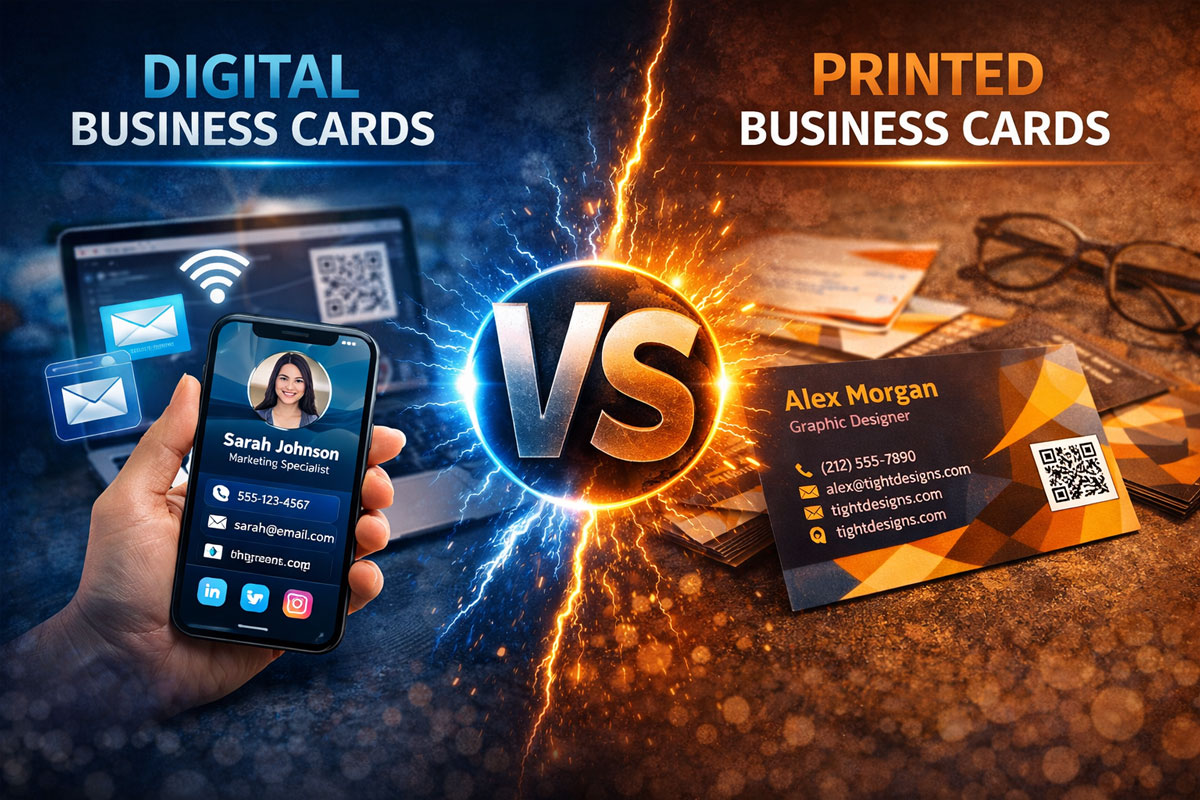
Digital business cards and printed business cards both help people share contact information, but they do it in very different ways. One is built for instant mobile interaction and easy updating. The other is built for physical handoff, local visibility, and real-world convenience. If you are comparing digital business cards vs printed business cards, the real question is not which one is newer… it is which one fits the way your business actually meets people, follows up, and gets remembered.
Digital vs printed business cards at a glance
| Factor | Digital Business Cards | Printed Business Cards |
|---|---|---|
| Main strength | Fast mobile sharing and easy updates | Physical handoff and easy real-world retention |
| Best use | Texting, email, networking with phones already out | Meetings, events, service calls, referrals, leave-behinds |
| Update flexibility | Very easy to change | Requires reprint when details change |
| Tangible presence | Low | High |
| Referral friendliness | Moderate | High |
| Best for local handoffs | Situational | Usually stronger |
The biggest difference is the handoff experience
A digital business card usually works best when the other person already has their phone in hand and is willing to engage with it right away. That can be convenient in the right setting. You can text a link, tap phones, share a profile, or let someone scan a code and save your information quickly.
Printed business cards work differently. They do not depend on that moment. You can hand one over in seconds, and the other person can deal with it later. That matters because many real-world business interactions happen when people are busy, distracted, walking, talking, working, or not ready to stop and do something on their phone immediately.
When digital business cards are usually the better choice
Digital business cards make more sense when flexibility and instant mobile access matter most. If your contact details change often, you want clickable links, or your networking style happens mostly through phone-based interaction, digital can be useful. They are also helpful when your goal is to send people to multiple destinations from one place… website, calendar, portfolio, social platforms, reviews, and contact details all in one screen.
- Great for mobile-first networking: especially when people are already texting or scanning
- Great for easy updates: no need to reprint when links or titles change
- Great for link-heavy follow-up: website, scheduler, portfolio, and socials can all live in one place
- Great for remote sharing: easy to send by text, email, or DM
Digital cards are often strongest when the interaction is already happening inside a digital environment.
When printed business cards are usually the better choice
Printed business cards usually win when your business depends on in-person interaction, local relationships, physical leave-behinds, and easy referral sharing. They work especially well for service businesses, realtors, consultants, medical offices, contractors, event vendors, and any business that meets people face to face in the real world.
- Great for service visits and estimates: easy to leave behind without friction
- Great for events and meetings: fast handoff with no tech required
- Great for referrals: people can keep them and hand them to someone else later
- Great for local presence: cards can sit on desks, counters, wallets, glove boxes, and drawers
Printed cards are often better when the goal is not just to share information, but to stay physically present after the conversation ends.
Digital cards are more flexible… printed cards are more durable in memory
This is one of the clearest tradeoffs. Digital cards are easier to change. If your number, title, website, booking link, or branding changes, you can usually update the destination without starting over. That is a real advantage for fast-moving businesses or people still refining their setup.
Printed cards, on the other hand, often stay with people differently. They are more likely to live in a wallet, on a desk, in a drawer, on a front counter, or in a truck. That physical presence can make them more memorable and more likely to be rediscovered later. In local business, that matters more than people think.
Printed cards often win in referral situations
One of the biggest strengths of printed business cards is referral sharing. A customer can hand your card to a neighbor. A front desk can keep a stack. A happy client can put it aside and pass it to a friend later. That kind of simple hand-to-hand sharing is still very powerful for local businesses.
Digital cards can be shared too, of course, but the referral path is often less natural. Someone has to remember where the link is, forward it properly, and assume the next person wants to open it. Printed cards make that exchange easier because they are already packaged for pass-along use.
If referrals matter a lot in your business, you may also want to read do business cards still work for local businesses?.
Digital cards often win in link-rich follow-up
Where digital cards tend to shine is follow-up depth. A printed card has limited space. A digital card can include multiple links, booking tools, maps, videos, testimonials, reviews, lead forms, and social profiles all in one destination. That makes digital stronger when you want someone to explore several paths from a single touchpoint.
This can be especially helpful for creatives, consultants, agencies, salespeople, and businesses that rely on more than one digital step to convert. If your contact exchange naturally continues through text or email, digital can feel very efficient.
Printed cards often fit local service businesses better
For many local service businesses, printed cards still have the edge. That is because local service work often happens in messy, busy, practical situations… jobsites, driveways, offices, homes, events, waiting rooms, counters, and community interactions. In those moments, handing someone a physical card is often easier than asking them to pull out a phone and do something right then.
That does not mean digital is useless. It means printed usually fits the environment better. A plumber, roofer, electrician, cleaner, realtor, or med spa may still benefit from digital follow-up, but the printed card often plays the more natural first-touch role.
If that sounds like your business, you may also want to read best business cards for service businesses.
Comparing them by business goal
| Business Goal | Usually Better Option | Why |
|---|---|---|
| Fast in-person handoff | Printed | No phone action required in the moment |
| Easy updates over time | Digital | Links and details can be changed without reprinting |
| Referral pass-along | Printed | Easier for one person to hand to another later |
| Link-rich follow-up | Digital | Can hold multiple destinations and actions |
| Local field use | Printed | Fits service calls, meetings, and leave-behinds better |
| Remote or text-based sharing | Digital | Easy to send instantly through phone-based channels |
The strongest answer for many businesses is not either-or
This is where the comparison gets more useful. Many businesses should not think in strict either-or terms. Printed and digital cards often work best together because they solve different problems. The printed card handles the physical handoff. The digital destination handles the deeper follow-up.
That can be as simple as a printed card with a QR code that leads to a digital profile, booking page, or contact-saving screen. In that setup, the printed card keeps the interaction easy, while the digital piece expands what happens next. That is often the smartest hybrid approach.
If that direction fits your business, our business cards with QR codes page can help you think through it.
Common mistakes people make in this comparison
- Assuming digital automatically replaces print: it often does not in local, in-person business settings
- Assuming printed is outdated: physical convenience still matters a lot in the real world
- Ignoring referral behavior: printed cards often travel better person to person
- Ignoring update needs: if details change often, digital may carry a real advantage
- Forcing one format to do everything: many businesses benefit from using both together
So… which one should you choose?
Choose digital business cards when mobile convenience, easy updates, and link-rich follow-up are your biggest priorities. Choose printed business cards when physical handoff, local visibility, referral sharing, and real-world convenience matter most. If your business operates in both physical and digital environments… which most do… the best solution may be a printed card that leads naturally into a digital experience.
Frequently Asked Questions
Are digital business cards better than printed ones?
Not always. Digital cards are better for updates and mobile sharing. Printed cards are often better for in-person handoffs, referrals, and local business situations.
Do printed business cards still matter?
Yes. They still matter a lot for local businesses, service businesses, events, meetings, and referral-driven situations.
Can I use both digital and printed business cards?
Yes… and for many businesses, that is the smartest move. One handles the handoff. The other handles the deeper follow-up.
What is better for service businesses?
Printed cards are often better for service businesses because they fit field use, leave-behinds, and referral sharing more naturally.
What is the main advantage of digital business cards?
The main advantage is flexibility… they are easy to update and can hold multiple useful links in one place.
Need Help?
If you are trying to decide whether digital, printed, or a hybrid approach makes the most sense for your business, it usually comes down to how you meet people and what you need them to do next. If you want help building the right kind of card for that job, contact Tight Designs here.