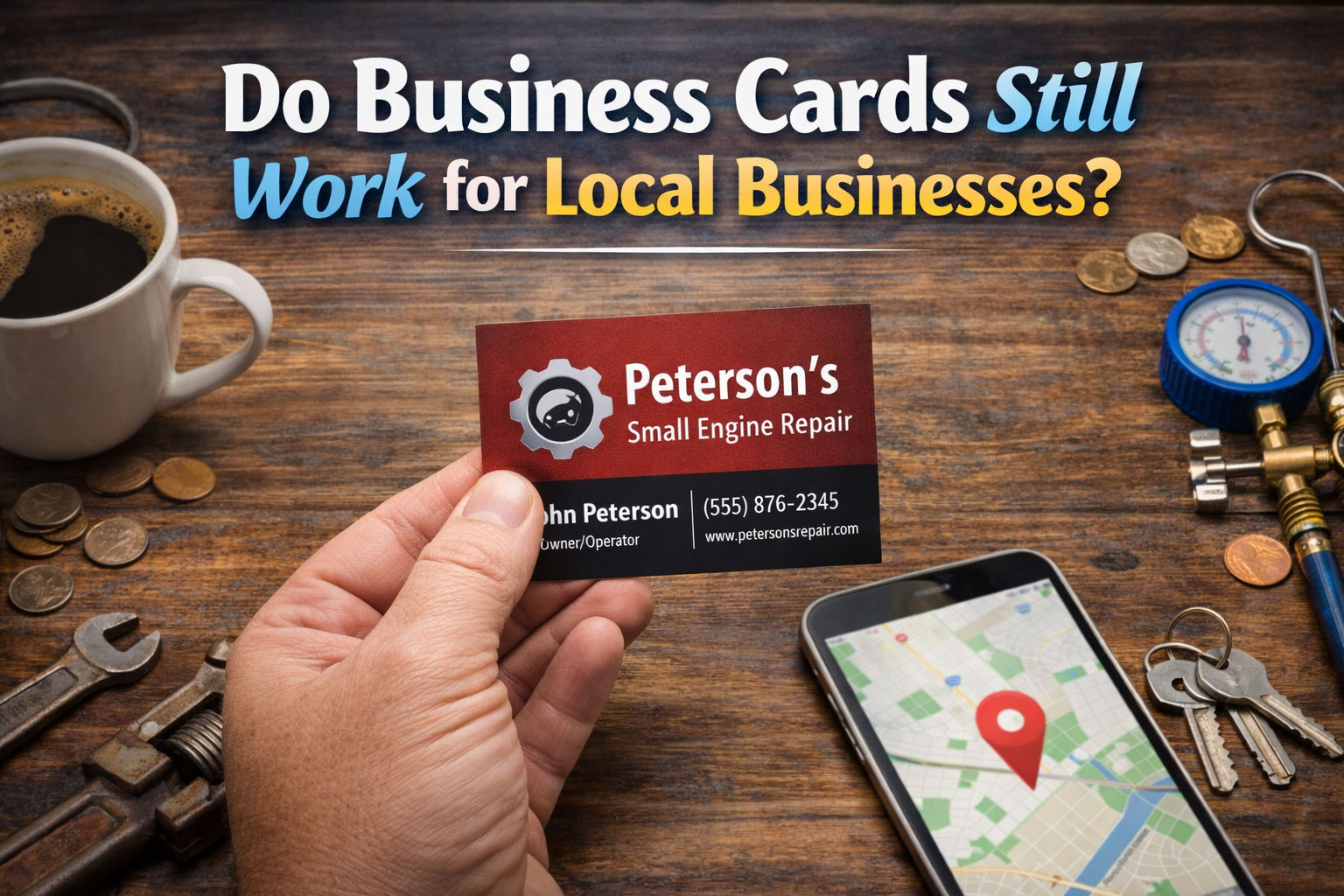
Yes… business cards still work for local businesses. They are not outdated just because digital marketing exists. What has changed is how they need to function. A business card is no longer just a piece of contact information. For a local business, it is a trust tool, a referral tool, and a convenience tool. When used correctly, it can still help generate calls, repeat business, word-of-mouth referrals, and stronger local brand recognition.
Why business cards still matter in a digital world
A lot of people assume business cards became irrelevant once websites, smartphones, and social media took over. But that logic misses how local business actually works in the real world. Many service businesses still win customers through conversations, face-to-face interactions, referrals, networking, site visits, events, front-desk interactions, and everyday encounters in the community.
In those moments, a business card gives people something immediate and tangible to keep. That matters because people do not always stop and type your information into their phone right away. Sometimes they are busy. Sometimes they mean to look you up later. Sometimes they want to pass your information to a friend, spouse, neighbor, or coworker. A business card makes that easier.
They are especially effective for local and referral-driven businesses
Business cards still work best for businesses that depend on trust, visibility, and easy follow-up. That includes home service companies, realtors, medical offices, contractors, consultants, attorneys, restaurants, salons, event vendors, and many other businesses that get customers through community presence and word of mouth.
For a local business, the card is often less about closing the sale on the spot and more about preserving the opportunity. It helps someone remember who you are, what you do, and how to reach you when the time is right. That is especially valuable when referrals are involved. A person may not need your service today, but they may know someone who does tomorrow.
- Easy to share: People can hand your card to someone else without needing to remember details
- Easy to keep: Cards can live in wallets, desks, glove boxes, drawers, and counters
- Easy to trust: A polished printed card can make the business feel more established and real
- Easy to revisit later: The card stays available after the conversation ends
What makes business cards still effective today
Business cards still work when they reduce friction and make the next step simple. That means the card needs to be readable, relevant, and designed with purpose. A weak card can still be ignored. A strong card can still drive action.
Modern business cards work best when they do at least one of these things well…
- Deliver clear contact information
- Reinforce a professional brand image
- Guide the next step with a simple call to action
- Connect print with digital through a QR code or clean web path
- Make referrals easier by clearly explaining what the business does
If the card just exists as a generic afterthought, it will not do much. But when it is built intentionally, it can still be a very useful business asset.
Why local businesses should not rely only on digital follow-up
Digital tools are powerful, but they do not replace every in-person touchpoint. Not every interaction happens in a perfect moment where someone is ready to search your name, visit your website, or save your number. A card helps bridge that gap.
For example, if you are a plumber finishing an estimate, a realtor meeting a prospect, or a med spa talking to someone at an event, a physical card gives people something they can keep without needing to stop everything and process your information right then. That small convenience matters more than people realize.
In other words… digital is important, but local business is still physical. Business cards help those two realities work together.
Business cards are not just for strangers
One mistake people make is thinking cards are only for first-time introductions. In reality, they also work well for repeat contacts, current customers, and referral partners. A customer may want extra cards to give to friends. A front desk may keep a stack available. A technician may leave one behind after a service call. A networking partner may keep your card in case someone asks for a recommendation later.
That means the card continues working after the original interaction. It becomes part of how your business stays present in the community.
What does not work anymore
What no longer works well is the old lazy version of a business card… generic layout, weak printing, tiny text, no clear message, no next step, and no thought behind how the card will actually be used. People are not impressed just because you have a card. The card has to earn attention.
That is why modern business cards need to be sharper and more strategic. They should feel aligned with your brand, easy to read, and useful in the real world. If the design looks cheap, the information feels cluttered, or the print quality is weak, the card can hurt as much as it helps.
If you want to avoid those issues, read business card mistakes to avoid.
How QR codes and digital tools have made cards more useful
One reason business cards still work is that they no longer have to do everything on their own. A card can now act as a simple gateway to something bigger… a website, booking page, gallery, offer page, contact form, or digital profile. That makes the card more flexible than it used to be.
Instead of trying to cram every detail onto a tiny printed surface, the card can create an easy path to the next action. That is especially helpful when the business has a long URL, a campaign-specific landing page, or a strong visual portfolio that cannot be shown in print.
If that approach fits your business, our business cards with QR codes page explains what to consider.
Why print quality still matters
If business cards are going to work, they need to feel like they belong to a real business that cares how it presents itself. That does not always mean expensive. It does mean intentional. The paper, finish, legibility, spacing, and overall polish affect how people perceive the business behind the card.
For local businesses especially, first impressions still carry weight. A flimsy card with poor readability may get dismissed faster. A clean, solid, well-printed card feels more credible. That small difference can influence whether someone keeps the card, calls later, or feels comfortable referring you to someone else.
To think through those print decisions, see our business card printing services page.
When business cards work best
Business cards are most effective when they are part of a broader local marketing and relationship strategy. They work well when you hand them out intentionally, leave them behind in the right situations, include them in customer interactions, and make sure the card actually supports a next step.
- After estimates or consultations
- At local networking events and community meetups
- At front desks and reception areas
- On service calls and field visits
- Inside packages, folders, invoices, or leave-behinds
- As referral tools for happy customers and partners
They work even better when the person receiving the card immediately understands what you do and what they should do next.
When they do not work as well
Business cards are less effective when they are treated like random giveaways with no thought behind them. If the design is forgettable, the business name is unclear, the contact info is hard to use, or the card has no practical role in your sales process, results will be weak. The problem in those cases is not that business cards are dead. The problem is that the card was not built to perform.
So… do business cards still work?
Yes… especially for local businesses. They still work because local trust, local visibility, and local referrals still matter. A business card gives people a simple way to remember you, reach you, and share your information with someone else. That is still useful, and in many industries it is still very effective.
The businesses that get the most from business cards today are the ones that treat them like a real marketing tool, not a box they check because they feel like they are supposed to have one.
Frequently Asked Questions
Are business cards outdated?
No. They are only outdated when they are generic, poorly designed, or disconnected from how the business actually gets customers.
Do business cards still help local businesses get customers?
Yes. They are especially useful for referrals, face-to-face interactions, community networking, and making follow-up easier.
Should I still have business cards if I have a website?
Yes. Your website and your business card should support each other. One lives online. The other helps people get there and remember you offline.
Do QR codes make business cards more effective?
They can… especially when they reduce friction and send people to a useful next step like booking, pricing, a portfolio, or contact page.
What kind of businesses benefit most from business cards?
Service businesses, referral-driven businesses, local professionals, and businesses that interact with people in person tend to benefit the most.
Ready to Build Together?
If you want business cards that feel professional, work in the real world, and support how your business actually gets customers, Tight Designs can help. Visit our business card page or contact us to get started.