If you are ordering business cards for the first time, or reordering after a long break, one of the most common questions is simple…
How many business cards should you order?
The answer depends on how you use them, who you give them to, how often your information changes, and whether your card is being treated like a casual handout or a serious sales tool.
Before deciding on quantity, it also helps to understand what to put on a business card so you are not overordering cards that still need changes.
Some people only need a small batch to cover occasional introductions. Others go through cards every month because networking, referrals, events, jobsite visits, or face to face sales are part of their routine.
The mistake is thinking there is one universal number that works for everybody.
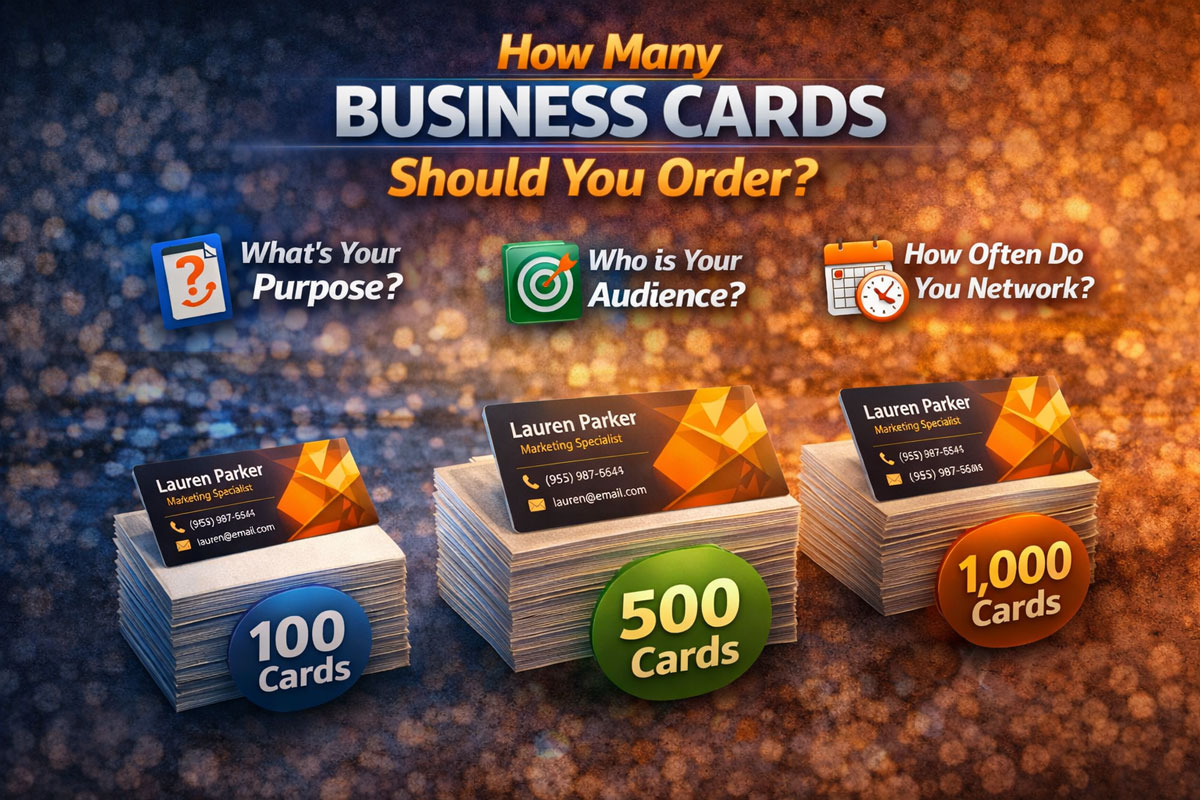
In this guide, we will break down how to think about quantity the right way, when 250 makes sense, when 500 is safer, when 1,000 is the smarter value, and why ordering too many can sometimes be just as wasteful as ordering too few.
The Right Quantity Depends on How You Actually Use Them
Before you choose a number, step back and ask a better question…
What job is this business card supposed to do?
A business card is not just something you hand out because people expect one. It is a tool. And the quantity you order should match the way that tool is used in real life.
For example:
- A realtor, insurance agent, or salesperson who meets new people constantly may go through cards much faster.
- A contractor or service business may leave cards behind at homes, counters, partner locations, or with past clients for referrals.
- A small business owner who only uses cards during occasional meetings may need far fewer.
- A startup testing a new offer, phone number, or message may not want to commit to a huge quantity yet.
So the real issue is not just how many cards can you afford.
It is how many cards can you realistically use before something changes.
That change could be:
- your phone number
- your email
- your website
- your logo
- your service offering
- your call to action
- your positioning
- your pricing
- your overall brand direction
If your card may need updating soon, a smaller quantity often makes more sense. If your business is stable and your message is dialed in, a larger order usually gives you better value.
A business card should not just look nice. It should still be accurate, relevant, and useful by the time you hand out the last one.
A Simple Rule of Thumb
If you want a practical starting point, here is a good general guide:
Order 250 cards if:
- you are testing a new design or message
- your information may change soon
- you do not hand out cards very often
- you want a short run for a niche event or campaign
Order 500 cards if:
- you use cards somewhat regularly
- your contact information is stable
- you want a safer middle ground without overcommitting
- you are a typical small business owner who wants enough for daily use
Order 1,000 cards if:
- you network often
- you leave cards behind in multiple places
- you have employees or multiple users
- you already know the card design and message are working
- you want better value per card
Order more than 1,000 if:
- you attend trade shows or community events
- you run a sales team
- you distribute cards at a high volume
- you are confident nothing important will change soon
For many small businesses, 500 to 1,000 business cards is the most practical range.
If you’re comparing options for business cards in Pembroke Pines, quantity is only one part of the decision. The right card stock, finish, message, and turnaround time matter too.
Why Ordering Too Few Can Cost You More
A lot of people try to save money by ordering the smallest possible quantity.
Sometimes that is smart. Often it is not.
Here is why.
When you order too few cards, you may end up:
- paying a higher cost per card
- reordering too soon
- rushing another order at the last minute
- running out right when you need them
- handing out fewer cards than you should because you are trying to conserve them
That last point matters more than most people realize.
If you are being selective with your cards because you are worried about running out, then the card is no longer doing its full job. You stop using it freely. You hesitate. You hold back. And that reduces opportunities.
A business card should be easy to give out when the moment is right.
You do not want to be thinking, I only have 20 left, so I better save these.
Why Ordering Too Many Can Also Be a Mistake
On the other hand, bigger is not always better.
Ordering a large quantity can backfire when:
- your business is still evolving
- your branding is not finalized
- your offer is unclear
- your call to action is weak
- your phone number or email might change
- you may want to improve the design after getting feedback
This is especially true for new businesses.
A lot of people launch with a card too early, print a huge batch, then realize later that the card was missing something important. Maybe the message was too vague. Maybe the design looked nice but did not explain what they actually do. Maybe the CTA was weak. Maybe the card attracted compliments but not calls.
That is one reason we often tell people not to treat business cards as just a printing decision.
They are also a messaging decision.
A nice card gets noticed… the right message gets a response.
If you are still figuring out your message, a smaller first run can be the smarter move.
Questions to Ask Before You Pick a Quantity
If you are unsure how many to order, ask yourself these questions:
1. How often do I actually meet new people?
If you rarely have in person interactions, you may not need a large batch.
2. Do I leave cards behind in places?
Some businesses do not just hand out one card. They leave several at a front desk, on a bulletin board, with a receptionist, or with a customer who may refer others.
3. Will my information stay the same for the next 6 to 12 months?
If not, be careful about ordering too many.
4. Am I testing a new business, new market, or new offer?
If yes, a smaller order gives you flexibility.
5. Do I want the lowest price per card, or the lowest total risk?
Those are not always the same thing.
6. Is this card for general use, or for a specific campaign?
A general evergreen card can justify a larger order. A niche campaign card may call for a smaller batch.
Typical Ordering Scenarios
Here is a more real world way to think about it.
For a new business owner
A new business owner often benefits from starting with 250 or 500 cards.
Why? Because new businesses tend to refine their message fast. The first version of the card is often not the final version.
For a stable local service business
A plumber, electrician, pressure cleaner, landscaper, mobile detailer, or contractor may be better off with 500 or 1,000 cards if their services and contact info are already settled.
These businesses often hand cards to homeowners, property managers, neighbors, referral partners, and repeat clients.
For networking professionals
Realtors, loan officers, insurance agents, attorneys, and business development people often need 1,000 or more, especially if they attend events regularly.
For employees or teams
If multiple staff members need cards, quantity rises fast. In that case, it may make more sense to order by user and forecast actual usage instead of guessing.
For a short term promotion
If the card includes a limited time offer, seasonal service, event push, or temporary CTA, keep the quantity lower unless you know the campaign will continue.
Do Most People Really Need 1,000 Business Cards?
Not always.
A lot of printers push higher quantities because the unit price looks better. And yes, from a pure math standpoint, larger runs usually lower the cost per card.
But that does not automatically mean 1,000 is the best choice for every customer.
Sometimes 500 is the better business decision because:
- it gives you enough cards for regular use
- it avoids overcommitting to a design or message
- it reduces waste if something changes
- it still gives you breathing room so you do not run out immediately
That said, if your business is established and your card is already working well, 1,000 is often the strongest value point.
The Cheapest Option Is Not Always the Best Option
This is where many people make the wrong comparison.
They ask:
How much do 500 cards cost versus 1,000 cards?
But a better question is:
Which quantity makes the most sense based on how this card will be used?
Because the wrong quantity can be expensive in ways that do not show up on the print invoice.
For example:
- ordering too many can lock you into weak messaging
- ordering too few can create reorders and rush costs
- using a poor card design at high volume can multiply the damage
- giving out lots of cards with no clear CTA can waste every interaction
So yes, quantity matters.
But it should come after the bigger question…
Is the card saying the right thing to the right person?
A Better Way to Decide
If you want a simple framework, use this:
Choose the smaller quantity if:
- your business is new
- your card design is not proven yet
- your branding may change
- your offer is still evolving
- you want flexibility
Choose the larger quantity if:
- your business info is stable
- your message is clear
- your card has already been working
- you hand them out consistently
- you want better long term value
This approach helps you avoid the two most common mistakes:
- printing too many before the card is ready
- printing too few once the card is working
Our Recommendation for Most Small Businesses
For many small businesses, 500 cards is the safest starting point.
It is usually enough to feel stocked without overcommitting. It gives you room to use the card confidently, test how people respond, and make adjustments later if needed.
Then, once you know the design, message, and CTA are solid, moving up to 1,000 cards often becomes the smarter value.
That is usually the sweet spot.
Final Answer… How Many Business Cards Should You Order?
If you want the most practical answer…
- 250 if you are testing
- 500 if you want a balanced, safe quantity
- 1,000 if your business card is proven and you use it often
There is no perfect universal number.
The best quantity depends on how often you use cards, how stable your business information is, and how confident you are that the card is saying the right thing.
Because in the end, ordering business cards is not just about printing paper.
It is about making sure the card you hand out is one you actually want working for your business.
FAQ: How Many Business Cards Should You Order?
Is 250 business cards enough?
It can be, especially for a new business, a trial run, or someone who does not hand out cards often. But for regular business use, 250 can go faster than expected.
Is 500 business cards a good amount?
Yes. For many small businesses, 500 is the most balanced starting point. It offers a practical quantity without committing too heavily.
Should I order 1,000 business cards?
You should consider 1,000 if your contact information is stable, your design and message are already dialed in, and you hand out cards regularly.
How long do 500 business cards last?
That depends entirely on your usage. For some people, 500 lasts a year. For others, it may only last a few weeks or months.
What if my business card design changes later?
That is exactly why some businesses start with a smaller batch. If your branding, phone number, offer, or CTA may change soon, avoid overordering.
Is it cheaper to buy more business cards at once?
Usually, yes. The cost per card often drops as quantity increases. But the cheapest unit price is not always the smartest overall decision if the card may need changes.